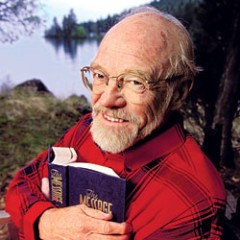
Eugene H. Peterson
1932 · 2 books on FireSoul · Christ Our King Presbyterian Church, Bel Air, Maryland, Regent College, Vancouver, British Columbia, New York Theological Seminary
Eugene H. Peterson (1932, 2018) was an American Presbyterian minister, translator, and spiritual theologian best known for The Message, his idiomatic rendering of the Bible into contemporary American English, which sold over 20 million copies. Across more than thirty books, Peterson argued that pastoral ministry and Christian spirituality are grounded in slow, attentive, embodied practice rather than institutional performance or celebrity culture. He spent twenty-nine years as founding pastor of Christ Our King Presbyterian Church in Bel Air, Maryland, and six years as James M. Houston Professor of Spiritual Theology at Regent College in Vancouver.
Books by Eugene H. Peterson

Biography
Eugene H. Peterson was a Presbyterian minister, Bible translator, and spiritual theologian who spent nearly six decades insisting that the Christian life is ordinary, embodied, and worth paying close attention to.
He was born on November 6, 1932, in East Stanwood, Washington, and his family moved to Kalispell, Montana, where he grew up. Those two landscapes, the wet Pacific Northwest and the wide cold interior, shaped him in ways that surfaced throughout his writing: a preference for the concrete over the abstract, a distrust of religious performance, and a genuine love for the physical world as the place where spiritual life actually happens. His mother was a Pentecostal preacher who carried the gospel to lumber workers in the camps and mill towns of Montana. His father was a butcher, and Peterson later wrote that watching his father work taught him the difference between a vocation and a mere job. That distinction became central to nearly everything he published about pastoral ministry. The craftsmanship ethic, learned at a counter where an animal was being transformed into something useful, ran through his understanding of what careful writing and careful pastoral attention had in common.
The education he assembled was wide by any measure. He earned a Bachelor of Arts in philosophy from Seattle Pacific University, then a Bachelor of Sacred Theology from New York Theological Seminary, and afterward a Master of Arts in Semitic languages from Johns Hopkins University. He began doctoral work in ancient languages at Johns Hopkins but didn’t finish the degree, a fact his admirers found slightly absurd given that no academic in the English-speaking world had done more to reconnect ordinary readers with the texture of ancient Hebrew and Greek. He held several honorary doctorates later in life, and before his pastoral career properly began he served briefly as an assistant professor at New York Theological Seminary. In 1958, he married Jan Stubbs. They had three children and, by his retirement years, six grandchildren.
Before any of the books, there was the parish. In 1962, Peterson co-founded Christ Our King Presbyterian Church in Bel Air, Maryland, and he served as its pastor for twenty-nine years, retiring in 1991. That isn’t a footnote to his career. It is the career. Almost everything Peterson wrote grew out of that one congregation, those one-on-one pastoral conversations, those weekly sermons to roughly five hundred people who were trying to figure out how to live. His son Eric Peterson grew up under that ministry in Maryland and became a Presbyterian pastor himself, serving at Colbert Presbyterian Church in the Spokane area. The continuity from father to son was quiet, unheroic, and exactly the kind of thing Peterson thought mattered most: a vocation passed along through presence rather than platform.
The congregation at Christ Our King was Peterson’s primary laboratory for the ideas that would eventually reach millions of readers. He was already writing throughout those Bel Air years, and he was already teaching himself to resist the trends that he thought were distorting pastoral ministry: the therapeutic model, the corporate growth model, the celebrity model. He emphasized the communal character of the gospel, its resistance to being reduced to a transaction between an individual and God, and he tried to build a church that operated on that premise. What happened there across nearly three decades of weekly work, the particular struggles of particular people, the rhythm of Scripture read aloud and slowly digested, the friction of community life, became the material for books that pastors would give each other for the next forty years.
Peterson left Bel Air in 1991 and joined Regent College in Vancouver, British Columbia, as the James M. Houston Professor of Spiritual Theology, a post he held from 1993 to 1998. (Some sources give 1992 as the year he joined; the Regent College archive specifies 1993.) Vancouver suited him in unexpected ways. The Christian community there, he noticed, worked hard to pray but not especially hard to play. His less religious neighbors, by contrast, spent their Sundays walking through the forests, eating well, paying careful attention to the natural world. He and Jan took up the same practice, spending quiet Sabbaths learning the names of plants and animals and birds, growing, as one friend put it, old and deeper in love together. Peterson began teaching his Christian students to bring the same quality of attention to rest that they brought to devotional discipline. It was a corrective he’d been working toward since Kalispell, and Regent gave him the sustained time and the right students to work it out fully. The course material he developed there eventually became the backbone of his five-volume spiritual theology series.
After Regent, he and Jan retired to Lakeside, Montana, on a lake near Kalispell where he had grown up. He spent the last two decades of his life writing there, largely avoiding public appearances and turning down most interview requests. Jason Byassee, a theologian at the Vancouver School of Theology who became a personal friend and organized a festschrift conference in Peterson’s honor, recalled that Peterson had a quiet, raspy voice that he never once heard raised. When Peterson spoke, rooms went still and people leaned in. The festschrift, a collection of essays responding to Peterson’s work that Byassee and colleagues assembled and presented to him at a conference, reduced Peterson to tears. “I’ve wept like a baby all weekend,” he told them, apparently genuinely surprised that anyone had thought his work worth that kind of attention.
In a 2016 video produced by his publisher NavPress, Peterson told a story about a Kingfisher he’d been watching at the lake one summer. He counted thirty-seven unsuccessful dives before the bird caught its first fish. The image stayed with him. “That Kingfisher became an icon for me for what pastors do,” he said. Thirty-seven dives. That was the work.
The book that made Peterson famous wasn’t the memoir or the pastoral theology series or the poetry. It was The Message: The Bible in Contemporary Language, published by NavPress in 2002 after a decade of translation work throughout the 1990s. Peterson worked directly from the Hebrew, Greek, and Aramaic source texts, rendering them not in formal equivalence but in the idiom of ordinary American speech, using a dynamic equivalence approach that aimed at reproducing the feeling of the original rather than its grammatical structure. He wanted Paul’s letters to sound the way they would have sounded to the people who first heard them read aloud: rough, immediate, without the patina of reverence that centuries of liturgical use had deposited on the language. As he explained it: “I began with the New Testament in the Greek, a rough and jagged language, not so grammatically clean. I just typed out a page the way I thought it would have sounded to the Galatians.” By 2018, The Message had sold more than 20 million copies. It had won the Gold Medallion Book Award. And it had reached readers who didn’t think of themselves as Bible readers at all.
Critics debated whether The Message was a translation or a paraphrase. Peterson’s answer, given graciously during a public event at Spokane Valley Church of the Nazarene in May 2006 and organized by Pastor Chuck Wilkes, was that the distinction collapses under examination: every translation involves interpretive judgment, and no word-for-word mapping from one language to another is actually possible. Wilkes watched the tension leave the room when Peterson said it. The congregation had submitted written questions on index cards, and the controversy over translation versus paraphrase showed up repeatedly. Peterson disposed of it so gently that the room felt different afterward. The way he made the point mattered as much as the point itself.
The Message reached audiences Peterson hadn’t anticipated. Bono of U2 became a personal friend and offered public tribute to the translation often enough that it became a minor recurring story in Christian media. The first time a message from Bono arrived, Peterson ignored it. He was translating Isaiah. A colleague pointed out that it was Bono. Peterson was unmoved. This was not performance. He genuinely didn’t understand the fuss, and he said so to Winn Collier, the writer who was at work on his authorized biography during Peterson’s final years. Peterson told Collier that his life had been nothing more or less than a gift and seemed baffled that it was receiving the attention it was. The New York Times ran an obituary. The Washington Post ran an obituary. Awards came. None of it seemed to change him.
His neighbor in Lakeside, Kelly Swenson, described The Message as best read devotionally alongside a study Bible, which is exactly how it was used in the women’s devotional group she shared with Jan Peterson. But Peterson’s idiomatic renderings of difficult Pauline passages introduced millions of readers to texts they’d found either impenetrable or simply dull, and that matters. A translation that gets read by twenty million people has done something that a more formally accurate translation sitting unread on a shelf hasn’t.
Peterson wrote more than thirty books across his career, and most of them were aimed at pastors. This was deliberate. He believed that the practice of ministry had been hollowed out by a combination of therapeutic culture, corporate management thinking, and the distortions of celebrity, and he wrote against all three, steadily and without drama.
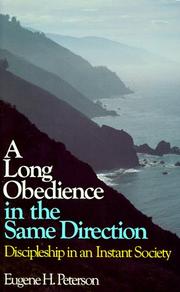
His most enduring pastoral book, A Long Obedience in the Same Direction, took its title from Nietzsche and its structure from the fifteen Psalms of Ascent (Psalms 120 through 134), reading them as a manual for discipleship in a culture that had lost patience with slow work. The book argued that the Christian life isn’t a series of peak experiences or transformative moments; it’s a long walk in one direction. It didn’t sell widely on first publication, but it found readers steadily over decades and became something close to a standard text in pastoral formation programs. Seminary students who read it in the 1980s assigned it to their students in the 2000s. That’s the kind of reach that outlasts celebrity.
Working the Angles argued that the real substance of pastoral ministry is prayer, Scripture reading, and spiritual direction. Three things invisible in a church’s annual report. Three things most likely to get cut when a pastor is under pressure to produce visible results. The book was a diagnosis and a prescription at once, and pastors who felt the pressure it described recognized themselves on every page.
Eat This Book made the case for lectio divina, the ancient practice of slow, meditative reading of Scripture, as the proper form of biblical engagement for ordinary Christians. Peterson was serious about reading itself, not just reading the Bible, but reading. He thought the speed at which modern people consumed texts had damaged their capacity to let those texts work on them, and his recommendations showed it: Gerard Manley Hopkins for the musicality of language, Fyodor Dostoevsky for the moral weight of fiction, Karl Barth for theological seriousness. His was a writer’s spirituality, which meant it was a reader’s spirituality too.
Barth was perhaps Peterson’s most significant intellectual influence among modern theologians. From Barth, Peterson took the conviction that the church’s job in any political moment is to keep doing theology with full attention, not to be distracted by whatever crisis is currently commanding the news cycle. Barth had modeled this under the Nazis: he’d gone on teaching, writing, and thinking, and he’d also authored the Barmen Declaration, the church’s most authoritative denunciation of totalitarianism from within that era. Presence and resistance weren’t opposites. Peterson understood Barth’s example as meaning that the person or the text directly in front of you is where faithfulness begins, and everything else follows from that or it doesn’t follow at all.
His five-volume spiritual theology series was the most systematic statement of his mature thought. The volumes were Christ Plays in Ten Thousand Places, Eat This Book, The Jesus Way, Tell It Slant, and Practice Resurrection. The series was built around a single conviction: Christian spirituality isn’t a specialized department of the religious life, something you add on after getting the doctrines right. It’s the whole thing. The Jesus Way examined how Jesus moved through the world and argued that the method of his ministry wasn’t separable from its content. Tell It Slant, the fourth volume, focused specifically on the language Jesus used, parables, stories, indirection, metaphor, and on what it means to speak truthfully about realities that resist direct statement. The title came from Emily Dickinson: “Tell all the truth but tell it slant.” Peterson thought that was a better description of how Jesus taught than any formal doctrinal account.
Leap Over a Wall, his extended reading of the David narratives, made the argument that David’s life, chaotic and compromised and fully human, is the proper lens for understanding what it means to live before God rather than to perform for him. The Pastor: A Memoir, the fullest autobiographical account of his development, traced the influences that shaped him: his mother’s Pentecostal preaching, his father’s butcher’s craft, the artists and writers who taught him that vocation is different from employment, the long practice of weekly parish ministry in Bel Air. It was a book about how a person becomes the kind of pastor who can actually help people, not a hero story but a formation story, much slower and less dramatic.
As Kingfishers Catch Fire, published in May 2017, was his final collection of sermons, its title drawn from Gerard Manley Hopkins. It became Peterson’s last major book published in his lifetime. Russell Moore, then president of the Southern Baptist Convention’s Ethics and Religious Liberty Committee, read it just before the same-sex marriage controversy broke and called it Peterson’s finest book yet. That judgment came from someone who was about to criticize Peterson publicly, which says something about the quality of the work.
Peterson’s theology was insistently shaped by the Hebrew Bible. He was firm that Christians can’t understand the New Testament without the Old, and he cited The Confession of 1967’s formulation with evident approval: “The Old Testament is indispensable to understanding the New, and is not itself fully understood without the New.” His MA in Semitic languages wasn’t incidental to his spiritual writing. It gave him direct access to the texture of the Hebrew texts, to the names and places and agricultural rhythms that underlie the Psalms, and he brought that material into his writing consistently. The Psalms, he believed, weren’t liturgical decoration. They were a school for prayer, and the school was still open.
In a piece later published by Christianity Today in December 2023 and drawn from the posthumous collection Lights a Lovely Mile, Peterson traced the whole arc of divine speech from Genesis through the prophets to the Incarnation. His argument was that the first words of God in Scripture were the simplest possible: “Let there be light.” One syllable. The most basic condition of existence, offered without theological complexity. As the centuries accumulated, he wrote, the vocabulary of God’s address to humanity grew more elaborate to match the increasing complexity of human life, through Moses, through the prophets, through Isaiah’s thunder and Jeremiah’s weeping. But the complexity threatened always to overwhelm itself. By the time of the scribes and rabbis, the original word was buried under commentary on commentary. What was needed, Peterson wrote, wasn’t another interpretation. It was a conclusion. And that conclusion was Jesus, who was not merely a messenger for God but God’s whole being made present: “his presence, his action, and his talk” were the word. Peterson came back to this claim repeatedly across his career and never found a simpler way to say it, because there wasn’t one.
There’s something worth sitting with here. Peterson spent his career insisting that the God of Abraham and the God revealed in Jesus are the same God, that the whole long history of Scripture is a single unbroken conversation, and that the traditions of ancient Israel are not pre-Christian leftovers but living inheritance. He was, in this sense, a bridge figure, not between denominations but between centuries. The Psalms he prayed with his Maryland congregation in the 1970s were the same Psalms prayed in Babylonian exile, in a medieval Cistercian monastery, in a Pentecostal church in Montana. That continuity was real to him. It’s one reason his work has been read by Catholics and charismatics and mainline Protestants and secular readers who didn’t know quite what category to put him in. Every tradition, every practice of prayer, every slow attempt to pay attention to what’s actually there, is part of the same inheritance. Peterson didn’t say that in those words, but he lived it.
In July 2017, Peterson gave an interview to Religion News Service in which he said his views on same-sex relationships had changed. He described gay and lesbian Christians he’d come to know through decades of ministry and said that homosexuality was “not a right or wrong thing as far as I’m concerned.” Asked directly whether he would perform a same-sex wedding ceremony for a couple in good faith, he said yes. The interview was published on July 12, 2017, and the response from conservative evangelical institutions was swift.
LifeWay Christian Bookstores, which had inherited the title of largest Christian bookstore chain in the country after Family Christian filed for bankruptcy earlier that year, announced plans to pull all of Peterson’s work, including The Message, from its 170 locations if the views were confirmed. Denny Burk, president of the Council on Biblical Manhood and Womanhood and professor of biblical studies at Boyce College, called the position “folly of the first order” and framed the question of homosexuality as “the watershed issue of our time, separating those who will follow the word of Christ from those who will not.” Russell Moore, writing for The Gospel Coalition, said he couldn’t un-highlight his Peterson books or erase what he’d learned from them, but he was hesitant to recommend Peterson to new or impressionable believers.
Within days, Peterson issued a retraction affirming traditional Christian teaching on marriage. The statement quieted some critics and disappointed others who had found his original answer courageous. His denomination, the Presbyterian Church (USA), had already formally endorsed same-sex marriage, so Peterson wasn’t breaking with his denominational home. He was breaking, or appearing to break, with the broader evangelical coalition that had made his books bestsellers and stocked his work in its stores.
Byassee, who had known Peterson personally through the festschrift years and afterward, offered what seems the most accurate account of what happened: Peterson thought about persons, not positions. He’d spent decades paying close, patient attention to whoever was in front of him. He could sit with parents raising a gay child and with quite conservative traditionalists and speak to both of the same mysteries. He had no framework for what Twitter would do with a single honest answer, and the scale of the reaction genuinely surprised him. He also, according to Byassee, had no real engagement with celebrity culture and was still mildly baffled by it when he died.
What the controversy exposed was how many different communities had claimed Peterson, and how uncomfortable that is when a person declines to stay tidy within any one of them. His denomination was one thing; the evangelical publishing and retail ecosystem was another; the pastors who’d been reading A Long Obedience in the Same Direction in their offices for thirty years were a third. He was never wholly any of theirs.
The books that shaped other writers and pastors most aren’t always the famous ones. A Long Obedience in the Same Direction is probably cited more often in seminary classrooms than The Message is. Working the Angles is the book pastors press into each other’s hands when one of them is burning out. Eat This Book changed how a generation of readers thought about what Scripture is actually for. The memoir The Pastor traced how a particular human being became the kind of pastor who could write those books, which is different from a book about how to become that kind of pastor, and the difference matters.
Peterson’s influence moved through named individuals as well as through titles. His son Eric carries the pastoral vocation into another generation. Winn Collier, who worked on Peterson’s authorized biography in Peterson’s final years, was formed by the relationship. Byassee’s festschrift project gathered a community of scholars who took Peterson’s work seriously as theology and not merely as popular inspiration. And the community at Regent College in Vancouver, where Peterson taught across five years, continued to carry his approach to spiritual formation into its curriculum long after he left. When Peterson died, the Regent chapel in Vancouver gathered to watch the livestream of his memorial in Montana.
He also left behind a particular way of reading Scripture that has no easy label. It isn’t academic exegesis and it isn’t devotionalism in the thin sense. It’s closer to what the poets do: close reading, attention to sound and image and texture, the conviction that the specific words matter and that skimming them for general ideas misses the point. He asked his readers to slow down, and a remarkable number of them did.
After Peterson died on October 22, 2018, in Lakeside, Montana, at the age of eighty-five, most of his writing continued selling as it always had: steadily, quietly, without requiring any new controversy to keep it moving. His neighbor Kelly Swenson remembered him, above all, as warm and hospitable, someone whose daily life and his life’s work both pointed toward the same thing: connectivity with actual people, the conviction that you can’t live a life of Christ without being present to the person directly in front of you. He’d said something like that in an early sermon, and he’d still been living it when he died.
The public memorial was held on November 3, 2018, at First Presbyterian Church of Kalispell, the Montana town where Peterson had grown up and where he now lies buried, with a livestream for those who couldn’t travel. The Regent College community in Vancouver gathered in the college chapel to watch it together. Among his last words, his family reported, were simply “Let’s go.”
Core Teachings
-
Slow, attentive discipleship
Peterson insisted that the Christian life is a long walk in one direction rather than a series of peak experiences. His book A Long Obedience in the Same Direction used the Psalms of Ascent (120–134) to argue for patient, sustained discipleship against a culture obsessed with immediate results.
-
Scripture as living address, not information
Through Eat This Book and his five-volume spiritual theology series, Peterson argued that Scripture must be read slowly and meditatively (lectio divina) rather than mined for data, and that the Old Testament is indispensable to understanding the New.
-
Jesus as God's conclusive word
Peterson’s theology held that Jesus is not merely a messenger from God but God’s own being made present — ‘his presence, his action, and his talk’ constitute the word. He traced the arc from Genesis through the prophets to the Incarnation as a single divine conversation reaching its conclusion in Christ.
-
Pastoral vocation as craft
In Working the Angles and The Pastor: A Memoir, Peterson argued that the invisible work of ministry — prayer, Scripture, spiritual direction — is its real substance, and that the institutional pressures to produce visible results corrupt the vocation. He drew on his butcher father’s example to frame pastoral work as craft rather than performance.
-
Communal rather than individual gospel
Peterson consistently emphasized that the message of Jesus is communal in its nature, not a transaction between an individual and God, and he built his twenty-nine-year parish ministry in Bel Air on that premise.
Lineage
- Teachers
-
- Karl Barth
- Gerard Manley Hopkins (literary influence)
- His Pentecostal mother (formative influence)
- Students
-
- Eric Peterson (son, Presbyterian pastor)
- Winn Collier (biographer, formed by relationship)
- Jason Byassee (theologian, Vancouver School of Theology)
Quotes
“I began with the New Testament in the Greek — a rough and jagged language, not so grammatically clean. I just typed out a page the way I thought it would have sounded to the Galatians.”
“That Kingfisher became an icon for me for what pastors do.”
“I don't think it's something that you can parade, but it's not a right or wrong thing as far as I'm concerned.”
“I've wept like a baby all weekend.”
“Let's go.”
External Links
- Eugene Peterson — Wikipedia (wikipedia)
- Regent College faculty page (archived) (academic)
- Religion News Service interview, July 2017 (interview)
- Christianity Today: excerpt from Lights a Lovely Mile (2023) (publisher)
- Vancouver Sun obituary by Jason Byassee (obituary)
- Spokesman-Review obituary, October 2018 (obituary)
- ChurchLeaders: LifeWay response to Peterson interview, 2017 (archive)
- Tell It Slant — Amazon listing (publisher)
- The Message: The Bible in Contemporary Language — Wikipedia (wikipedia)
- Regent College — Wikipedia (academic)