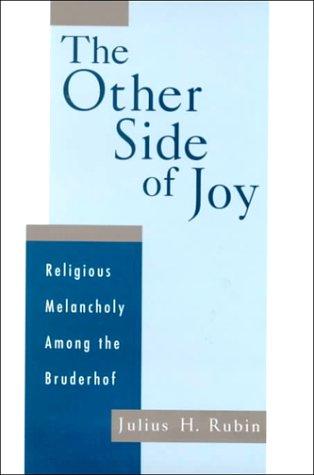
other side of joy, The
religious melancholy among the Bruderhof
Julius H. Rubin
264 pages | ~7 hrs
other side of joy, The
religious melancholy among the Bruderhof
By Julius H. Rubin
The Other Side of Joy offers a penetrating examination of what happens when spiritual communities pursue absolute unity at the cost of individual well-being. Julius H. Rubin chronicles the evolution of the Bruderhof, a Christian communal movement that began in 1920s Germany with high ideals of shared faith and collective living.
Through careful historical analysis, Rubin reveals how the community's noble aspirations gradually transformed into something far more troubling. As the founding generation passed away, leadership became increasingly authoritarian and patriarchal, moving away from the original vision toward rigid control and religious discipline borrowed from Hutterian traditions.
At the heart of this study lies a profound psychological insight: the phenomenon of "religious melancholy," a form of spiritual depression characterized by feelings of divine abandonment. Rubin demonstrates how this condition emerged within the Bruderhof community and traces similar patterns among other Anabaptist groups including the Mennonites, Brethren, Amish, and Hutterites.
The book presents a sobering conclusion about utopian religious communities that demand complete surrender of individual identity. Rubin argues that any group seeking perfect harmony and total conformity of thought and action inevitably creates psychological suffering for many of its members.
This work serves as both historical documentation and cautionary tale, offering valuable insights for anyone interested in understanding the complex dynamics between spiritual seeking, community belonging, and mental health.
What You'll Discover
- ✓ Explore History of doctrines
- ✓ Explore Religious aspects
- ✓ Explore Epidemiology
- ✓ Find practices to overcome depression
- ✓ Explore Christianity
- ✓ Explore Bruderhofgemeinschaft
- ✓ Explore Depression
- ✓ Explore Membership
Topics
Details
- Published
- 2000
- Publisher
- Oxford University Press
- ISBN-10
- 0195119436
- Pages
- 264
- Language
- EN
- LC Classification
- BX8129.B65 R83 2000


