
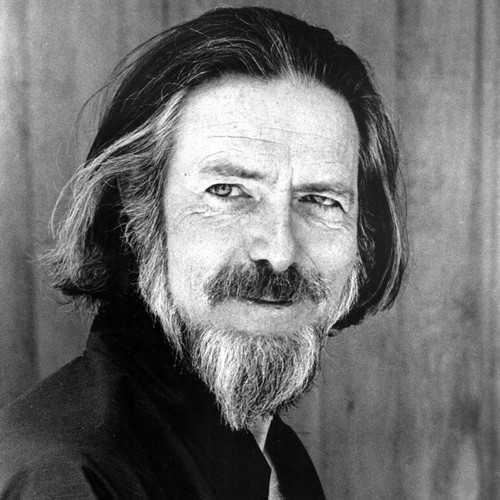
Alan Watts
1 book on FireSoul · Zen Buddhism, Taoism, Vedanta, Episcopal Christianity, Comparative Religion
Alan Watts was a British-born philosopher and broadcaster who spent four decades translating Zen Buddhism, Taoism, and Vedanta into language accessible to Western audiences, building a national following through radio, television, and more than twenty-five books. Born in Chislehurst, Kent in 1915, he was engaging with Buddhist teachers in London as a teenager and published his first book on Zen at twenty-one. He died in Marin County, California in November 1973, and his recorded talks continue to reach new audiences through the Alan Watts Organization.
Books by Alan Watts
Biography
Alan Watts spent his life doing something genuinely difficult: taking ideas most Westerners had never encountered and making them feel not foreign but obvious.
He was born on January 6, 1915, in Chislehurst, Kent, a market town on the southeastern fringe of London. His mother worked at a nearby boarding school whose pupils were often the children of families who had served in China as missionaries. Those families came back with things: painted landscapes, ceramics, small decorative objects animated by a vision of the natural world that had nothing in common with the English parish tradition. The objects filled the Watts household, and Alan grew up among them before he could have named what they were showing him. His father took him to the Buddhist Lodge in London, which turned out to matter enormously. There the teenage Watts met D.T. Suzuki, the Japanese scholar whose work on Zen would eventually reach millions of Western readers, and Christmas Humphreys, who had founded the Lodge and was among the central figures in British Buddhism at the time. Watts became editor of the Lodge’s journal, The Middle Way, and by sixteen he was also serving as secretary of the London Buddhist Association, which Humphreys had established. He later said that as a small boy his ambition was to grow up to be a mysterious Chinese villain, after reading Lafcadio Hearn’s Glimpses of Forgotten Japan and the Fu Manchu novels. That sounds like wit. It wasn’t entirely.
In 1932, before he’d finished secondary school, Watts wrote his first booklet: An Outline of Zen Buddhism. He was seventeen. At twenty-one, the same year he met Suzuki in person, he published The Spirit of Zen: A Way of Life, Work, and Art in the Far East. A young Englishman with no university degree and no formal Zen training producing a creditable book on the subject at that age isn’t something to note and move past. The work was the product of roughly a decade of genuine study, access to some of the best-informed teachers then working in Europe, and a mind that was constitutionally drawn to synthesis rather than to the defense of a single position. Watts wasn’t trying to become a Zen monk. He was trying to understand what the tradition pointed toward and then render it in English for people who had never thought about such things. The Spirit of Zen went through multiple reprintings and stayed in print for decades.
In 1938 he moved to New York, intending to deepen his study of Zen more directly. He began lecturing in bookstores and cafes to small, curious audiences and called it a trial run. A publisher paid attention. The Meaning of Happiness appeared in 1940, built from those talks. It came out, with some irony, at the start of the Second World War, when happiness wasn’t a widely discussed priority. The book didn’t find a large readership, but it established something important: Watts could hold philosophical complexity without academic scaffolding, and he could write for general audiences without talking down to them. His time in New York also began a pattern that would define everything that followed. The lecture was the primary form; the book was the secondary record. He thought on his feet, in front of people, and the writing came after.
He enrolled next at Seabury-Western Theological Seminary in Chicago, drawn by a longstanding interest in Christian mystical theology: Meister Eckhart, the apophatic tradition, that strand of Christian thought which insists God can’t be named, only circled. This wasn’t a retreat from Eastern philosophy. It was the same inquiry widened. He was ordained as an Episcopal priest in 1944 and became chaplain at Northwestern University in Evanston, Illinois. The appointment gave him an audience, a pulpit, and institutional framing the bookstore circuit lacked. But his sermons weren’t conventional. He was preaching something closer to non-dualism than Trinity doctrine, and the parish context couldn’t hold it for long. By spring 1950 his time as a priest was over. He left Chicago for a small farmhouse outside Millbrook in upstate New York. There, in enforced quiet, he wrote The Wisdom of Insecurity: A Message for an Age of Anxiety, a book that spoke directly to the postwar mood and remains among his most incisive. The thesis is simple and unsparing: security isn’t acquired; it’s what’s left when the attempt to acquire it is abandoned.
He didn’t stay long in Millbrook. In early 1951 he relocated to San Francisco at the invitation of Dr. Frederic Spiegelberg, a scholar of comparative religion who had recently helped found the American Academy of Asian Studies. Watts joined the faculty to teach Buddhism. His classes filled quickly and grew into evening lectures open to the public, which spilled out into coffee houses on the edges of campus where Beat poets, writers, and the spiritually restless gathered. This was the San Francisco world that would produce the Beat Generation’s engagement with Zen, and Watts was at its center before Jack Kerouac had written a word of The Dharma Bums. He became Dean at the Academy in the early 1950s, though the institutional title suited him less well than the room itself. The Academy was, by his own account, the most fertile period of his intellectual life: East Asian scholars, poets, artists, and seekers moving through the same rooms, arguing about the same questions, none of them with final answers.
He took a Saturday evening slot on Berkeley’s KPFA radio station in 1953, starting a broadcast series called The Great Books of Asia. By 1956 the show had become Way Beyond the West, and that program was the engine that built his national reputation. Early recordings from KPFA show what made the broadcasts work: Watts talked to listeners the way a thoughtful friend talks, informed but not pedantic, willing to say something strange and trust the audience to follow. He reached people who had never read a word of Zen or Taoist writing. The format rewarded his specific gifts. He was a natural oral thinker, quick and associative, capable of moving between Zhuangzi and cybernetics and Christian mysticism in a single breath without losing the thread.
The 1957 bestseller The Way of Zen gave the Zen Boom its most widely read handbook. It was reviewed seriously, sold broadly, and argued over on campuses and in coffee shops from Berkeley to New York. Two years later, in 1959, the public television series Eastern Wisdom and Modern Life aired its first season, and a Look magazine feature visited him at home, surrounded by his children. He was forty-four and at the height of his mainstream visibility.
The 1960s accelerated everything. He toured colleges regularly and began recording his talks systematically. Those recordings fed back into the weekly radio series and were rebroadcast across the country. The audiences weren’t, for the most part, academic. They were the young and the spiritually restless, people who sensed something missing from the dominant Western account of what a human life was for, an account built around accumulation, progress, and a self always straining toward a future that kept receding. Watts never claimed to be a guru. He called himself, with characteristic precision, a philosophical entertainer. He didn’t endorse a path or prescribe a practice. He offered what he described as triangulation: comparing the worldviews of Zen, Taoism, Hinduism, and Vedanta so that a person might locate themselves more accurately in the larger territory of human experience, the way a navigator uses three landmarks rather than one. The method was deliberate. A single tradition taken alone, he thought, tended to calcify into doctrine. Set two or three beside one another and the doctrine loosened, the living thing underneath became visible.
This Is It, published in 1962, is one of the clearest expressions of what that triangulation produced. Its central claim is stated without qualification: “This, the immediate, everyday, and present experience, is IT, the entire and ultimate point for the existence of a universe.” He wasn’t arguing for quietism or passive acceptance. He was pointing at something most Western philosophies had systematically obscured: that seeking meaning somewhere other than here, in some future achievement or transcendent elsewhere, is itself the engine of the anxiety it promises to cure. The self that’s always seeking is the same self that can never arrive. This Is It stands as one of the most readable introductions to the non-dualist position ever written in English, and it’s readable because Watts refused jargon as a matter of principle, not because he lacked the technical vocabulary. He had it; he didn’t trust it to do the work he needed done.
His engagement with Taoism ran as deep as his engagement with Zen, and in some ways it suited his temperament better. The concept he returned to most consistently in his later work was wu wei, the Taoist principle usually translated as non-action but which Watts rendered more carefully as acting in accordance with the natural grain of things, the way water moves through a landscape rather than against it. His final television appearance in 1972 returned to what he called the watercourse way: navigating with course and current and the grain of nature rather than forcing passage through it on the strength of will alone. He connected this to the Buddhist concept of upaya, skillful means, and to what the Taoists called ziran, that which is so of itself. The suggestion wasn’t that we should be passive. It was that most of what we call effort is actually resistance, and resistance is exhausting. Still the Mind, drawn from recorded talks on meditation, extends this into practical territory. It isn’t a how-to manual. It’s a sustained argument that meditation isn’t a technique to be learned so much as a rediscovery of what the mind does when it isn’t being consciously directed.
Watts wasn’t a Buddhist teacher in any institutional sense. He held no dharma transmission, claimed no lineage authority, ran no sangha. He wasn’t a Taoist sage or a Vedantin scholar. He moved among traditions the way a good reader moves among books: drawing on each, exclusive to none, convinced that the distinctions Western thought insisted on between self and world, between the sacred and the ordinary, were among the chief fictions producing suffering. We tend to argue about whether that makes him a dilettante or a genuine synthesist. The argument is probably less interesting than what he actually produced.
What Zen, Taoism, Vedanta, and early Christian mysticism share, beneath their doctrinal differences, is a refusal to treat the present moment as merely instrumental, as a step toward somewhere else. That refusal isn’t easy to hold in a culture organised around optimization and future-orientation. Watts could say it plainly, say it with lightness, and not lose the urgency underneath. That combination is harder than it looks, and it’s why the recordings and the books keep finding new readers.
His influence on the generation that came of age in the 1960s was direct as well as broadcast. David Chadwick, who later wrote Crooked Cucumber, the major biography of Shunryu Suzuki, counted Watts as a friend and recalled him as someone who did as much as anyone to introduce Americans to Buddhism. D.T. Suzuki and Watts together form something like the twin poles of how Zen entered American culture: Suzuki the rigorous scholar rooted in Japanese institutional practice, Watts the brilliant popularizer working outside any institution. Each made the other’s work more accessible by existing. Suzuki gave intellectual seriousness to a subject the academy hadn’t taken seriously; Watts gave that same subject a voice that didn’t require a doctorate to follow. The Beat writers, Allen Ginsberg and Gary Snyder among them, moved through the same San Francisco world Watts inhabited in the early 1950s, and the cross-pollination ran in all directions.
He authored more than 25 books over his lifetime, among them Become What You Are, The Tao of Philosophy, and Still the Mind, alongside the earlier The Wisdom of Insecurity, The Way of Zen, and This Is It. Across all of them, the written prose is secondary in a specific sense: Watts thought first in speech. He wasn’t a writer who lectured. He was a talker whose words were sometimes caught in print, preserved the way you’d preserve a recording, incomplete without the room and the timing. The books that came directly from transcribed talks carry that quality most visibly. But the best of his written prose, The Wisdom of Insecurity in particular, shows how fully he could translate the spoken rhythm into sentences that work on the page without sounding like a transcript.
Watts died on November 16, 1973, in Marin County, California. He was fifty-eight. In 1973, his son Mark Watts and Henry Jacobs established the Alan Watts Electronic University to preserve and distribute his recordings, an archive that has grown steadily in the decades since. The Alan Watts Organization continues to maintain and release material from the KPFA sessions and the lecture tours. Mark Watts is also building the Alan Watts Mountain Center north of San Francisco, a physical home for work that has lived, until now, mostly in the air where Watts always preferred it.
Core Teachings
-
The Wisdom of Insecurity
Security isn’t something that can be acquired or accumulated; it’s what remains when the compulsive attempt to secure the future is released. Anxiety about the future is itself the obstacle it claims to address.
-
This Is It: the primacy of present experience
The immediate, everyday, present experience is the entire and ultimate point of existence. Searching for meaning in some future achievement or transcendent elsewhere is the engine of the very anxiety it promises to cure.
-
Wu Wei and the watercourse way
The Taoist principle of wu wei, rendered by Watts as acting in accordance with the natural grain of things, suggests that most of what we call effort is actually resistance. Navigation with the current of nature is more intelligent than forcing passage against it.
-
Cross-traditional triangulation
No single tradition taken alone can avoid calcifying into doctrine. Setting Zen, Taoism, Hinduism, and Vedanta beside one another loosens the doctrine and allows the living insight underneath to become visible.
-
Non-dualism: the dissolution of self and world
The distinctions Western thought insists on between self and world, and between the sacred and the ordinary, are among the chief fictions producing suffering. Watts drew on Zen, Vedanta, and Christian mysticism to point toward what lies beneath those distinctions.
Lineage
- Teachers
-
- D.T. Suzuki
- Christmas Humphreys
- Frederic Spiegelberg
- Students
-
- David Chadwick
Quotes
“This, the immediate, everyday, and present experience, is IT, the entire and ultimate point for the existence of a universe.”
External Links
- Alan Watts Organization: Biography (official_site)
- Alan Watts Organization: Our Story (official_site)
- Alan Watts Organization: Team and Electronic University (foundation)
- Encyclopaedia Britannica: Alan Watts (academic)
- Lion's Roar: Celebrating Alan Watts (archive)
- Lion's Roar: Alan Watts author page (archive)
- Lion's Roar: David Chadwick obituary (archive)
- Lion's Roar: Book Briefs Fall 2010 (Watts and D.T. Suzuki) (archive)
- University at Buffalo Libraries: Western Buddhist Teachers (academic)
- Scribd: Alan Watts Wikipedia archive PDF (archive)