
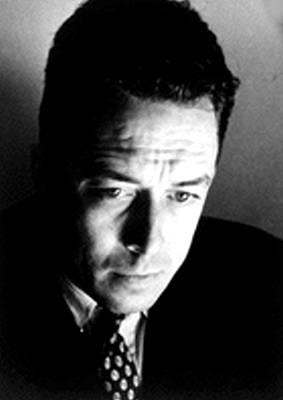
Albert Camus
1913–1960 · 0 books on FireSoul · University of Algiers
Albert Camus, the French-Algerian writer who won the 1957 Nobel Prize in Literature at 44, built his fiction on questions first raised in a university thesis on Christian mysticism. His letter of thanks to his childhood teacher Louis Germain, written the day he learned of the Nobel, reveals how deeply his early poverty in Algiers shaped everything that followed.
Biography
French-Algerian by birth and by temperament, Albert Camus turned philosophy’s bleakest question, whether life means anything at all, into a case for living anyway. At 44 he took the Nobel Prize in Literature in 1957, making him the second-youngest person to win it and the first laureate born on African soil. Readers know him for The Stranger, The Plague, and The Myth of Sisyphus. Fewer know that his university thesis dealt with Christian mysticism, and that unglamorous piece of coursework reveals something the fiction only hints at: Plotinus and Augustine shaped him nearly as much as the sun and sand of Algiers did.
Mondovi, in French Algeria, is where he entered the world on 7 November 1913, into a household with almost nothing to its name. His father, Lucien Camus, died in October 1914 in a Zouave regiment during the Battle of the Marne; Albert was eleven months old and would never know him. Deaf, illiterate, and left to raise her sons alone, his mother Catherine Hélène Sintès brought the boys up in the Belcourt district of Algiers, with a grandmother nearby who ran the house sternly. Books were scarce in that home. But a schoolteacher named Louis Germain saw something in the boy and pressed his mother to let him compete for the Bourses, the scholarships that eventually opened the door to secondary school and then the University of Algiers (Compagnie Affable). Camus carried that debt for the rest of his life. The very night he learned of his Nobel win in 1957, he sat down and wrote to Germain, right after writing to his mother: “Without you, without the affectionate hand you extended to the small poor child that I was, without your teaching and example, none of all this would have happened,” dated 19 November 1957 (Open Culture).
The reply came the following spring, on 30 April 1959. Germain addressed him as “mon petit Camus” and dwelled on the “pudeur instinctive,” an instinctive modesty he said he’d noticed in the boy long before anyone could have guessed what he’d become. He also confessed that he’d had no real sense of the family’s hardship until Camus’s mother turned up about the scholarship list; before that, the boy had always seemed as well kept as his classmates, which Germain took as proof of how hard the mother had worked to hide the struggle (Compagnie Affable). Letters passed between the two men for years afterward. Small as that correspondence is, it says something big: success never loosened Camus’s tie to where he began, and Germain never let him forget it either.
Philosophy became his subject once he reached the university, and this is where the Christian-mystic strand of his thinking takes root. For his diploma of higher studies he wrote Métaphysique chrétienne et néoplatonisme: Plotin et Saint Augustin, “Christian Metaphysics and Neoplatonism: Plotinus and Saint Augustine” (dokkyo.ac.jp). Placed beside The Stranger, it looks almost like the work of a different writer. In it, Camus tracked how the mystical, world-transcending impulse in early Christianity, passed down through Plotinus’s Neoplatonism, ran up against Augustine’s insistence on sin, grace, and a God who intervenes and answers. He wasn’t defending belief. He was probing whether any notion of transcendence could hold up against a universe that refuses to explain itself, and that same probing question runs underneath everything he wrote later. Set the thesis next to the novels and the throughline is obvious: a young man spends a year immersed in Augustine’s Confessions and Plotinus’s Enneads, then spends the rest of his career writing about what remains once the metaphysics is stripped away.
By 15 June 1942 that tension had found its clearest expression, in the published form of Le Mythe de Sisyphe (Wikipédia). Its central question: is life worth living once you accept that the universe supplies no ultimate meaning, no answer of the kind religion used to offer? Nihilism wasn’t his answer. Revolt was: keep pushing the boulder, and find something like dignity in the pushing itself. Condemned to roll his rock up the hill forever, Sisyphus becomes, in Camus’s telling, a happy man, precisely because he’s given up waiting on the gods to justify the effort. Underneath that argument you can still hear the university thesis, not as doctrine now but as an unfinished conversation Camus kept having with himself, minus the God he’d studied closely and then set down. Barely longer than an essay, the book nonetheless did more to define his reputation than anything he wrote afterward.
When Paris fell to German occupation in 1940, Camus had already relocated from Algiers to mainland France. He tried to leave, failed, and joined the Resistance instead, eventually rising to editor-in-chief of the underground paper Combat. Printing and distributing it meant working in secret, under a masthead that could get everyone on staff shot if it landed in the wrong hands. Fame followed the war, invitations poured in from everywhere, and Camus grew steadily more wary of them. In 1946 he published the essay Ni victimes ni bourreaux, “Neither Victims nor Executioners,” arguing against the logic of revolutionary violence then tearing apart the postwar French left (Éditions Ellipses). Friendships broke over it, most notably with Jean-Paul Sartre, who took Camus’s refusal to excuse Soviet violence as a betrayal of the cause itself. Camus wouldn’t budge. He’d already spent a year of university work untangling what happens to moral certainty once you remove a guaranteeing God, and he wasn’t going to hand that same certainty over to a party in God’s place.
It’s worth pausing on the strangeness here: a writer remembered chiefly for godless absurdism spent his most rigorous academic year buried in Augustine. Existentialist was a label Camus rejected his whole life, and the thesis explains why it never quite fit. He wasn’t pushing back against Christian mysticism so much as dragging its questions into a world he’d concluded couldn’t answer them the old way anymore. That isn’t atheism as rejection. It’s atheism as inheritance, and it’s a far more interesting stance than either side of that old argument usually grants him.
Two marriages and two children, a son and a daughter, filled out his personal life, and by the late 1950s things had grown crowded enough to worry the people who’d known him longest. In that same 1959 letter, Germain fretted that his former pupil was spreading himself too thin, between the Nobel, a stage adaptation of Dostoevsky’s Les Possédés, talk of André Malraux handing him a theater to direct, and a wife and two children who needed him at home rather than fielding questions about The Possessed on television (Compagnie Affable). Watching that broadcast, Germain wrote, had moved him and made up in part for how seldom Camus returned to Algiers. The old teacher, a committed secular schoolmaster by his own description, used the same letter to defend how he’d handled religion in his classroom decades before, saying he’d always been careful never to push his own views on children old enough to search for truth on their own. There’s something tender and strange about it, an elderly instituteur laïc still teaching his most famous student a lesson, this one about restraint.
The theater never happened. On 4 January 1960, Camus died in a car accident near Sens, in Burgundy, at age 46, an unused train ticket reportedly still in his pocket. Investigators found The First Man, his unfinished autobiographical novel, in the wreckage; it wasn’t published until decades later, its appendix preserving the real letters between the boy from Belcourt and the teacher who’d refused to let him vanish into poverty. As for the thesis on Plotinus and Augustine, most readers have filed it away as student juvenilia from a man who went on to write The Stranger. It’s there for anyone willing to look, though, and it remains the clearest record of where the questions in his fiction actually began.
Core Teachings
-
The Absurd and Revolt
Camus argued that life offers no ultimate meaning or metaphysical answer, but that the honest response is not despair, it is revolt: continuing to act, create, and live fully in spite of that absence of meaning, as dramatized in The Myth of Sisyphus.
-
Rejection of Existentialism
Despite being grouped with existentialists, Camus rejected the label throughout his life. His thought grew less from a reaction against religious belief than from carrying forward the questions of Christian mysticism into a world he saw as incapable of answering them theologically.
-
Neither Victims Nor Executioners
In this 1946 essay, Camus rejected the logic that revolutionary ends justify violent means, a position that put him at odds with much of the postwar French left and ended his friendship with Jean-Paul Sartre.
-
Debt to Formation
Camus’s public gratitude toward his elementary teacher Louis Germain, expressed at the height of his fame, reflects a recurring theme in his life and work: that dignity and possibility can come from ordinary acts of care, not only from grand ideas.
Lineage
- Teachers
-
- Louis Germain
Quotes
“Without you, without the affectionate hand you extended to the small poor child that I was, without your teaching and example, none of all this would have happened.”
External Links
- Albert Camus (French Wikipedia) (wikipedia)
- Camus's letter to Louis Germain, 1957 (archive)
- Germain's reply to Camus, 1959 (archive)
- Camus's university thesis on Plotinus and Augustine (academic)
- Excerpt, Neither Victims Nor Executioners (academic)
- OpenEdition Books, Camus scholarship (academic)
- Letters of Note, correspondence archive (archive)
- Dictionary.com entry, Camus (academic)