
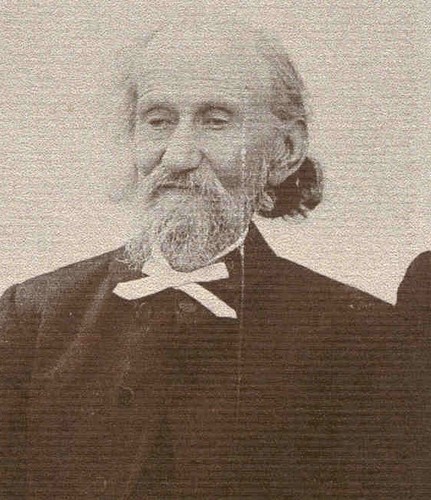
Andrew Murray
1 book on FireSoul · Dutch Reformed Church, Keswick Convention, Het Réveil, Higher Life / Inner Life movement
Andrew Murray (1828, 1917) was a South African Dutch Reformed pastor, institution-builder, and prolific devotional author whose books on prayer, humility, and surrender circulated in dozens of languages and made him a formative influence on the global Keswick and early Pentecostal movements. Born in Graaff Reinet and trained at Aberdeen and Utrecht, he spent his ministry in frontier and urban South African parishes before becoming arguably the nineteenth century’s most widely read writer in the Higher Life tradition. His output of more than 240 books and tracts, including enduring titles such as Abide in Christ, Humility, and With Christ in the School of Prayer, continues in print across multiple languages.
Books by Andrew Murray

Biography
Andrew Murray spent eighty-eight years moving between two kinds of work: the slow accumulation of a pastoral life in the interior of southern Africa, and the relentless production of devotional books that eventually reached readers in dozens of languages on every inhabited continent.
His mother, Maria Susanna Stegmann, brought French Huguenot and German Lutheran lineage into the household. It wasn’t a background that could be reduced to one ecclesiastical temperature: Reformed severity and Pietist warmth both ran through the family, and they’d eventually run through everything Andrew Murray wrote, in different ratios depending on the book, the decade, the crisis at hand.
He was fifteen when he and his elder brother John left for Scotland, enrolled at the University of Aberdeen, and spent several years in a cultural moment that was, for evangelical Christianity, unusually charged. Both brothers earned their master’s degrees in 1845. But the academic credential was arguably the least of what Aberdeen gave him. The three figures who shaped him most weren’t professors: Robert Murray McCheyne, the Dundee minister whose brief and burning life had already become a kind of devotional archetype; Horatius Bonar, the hymn-writer who turned the ordinary believer’s interior life into serious literary subject matter; and William Burns, a revivalist whose plain preaching kept producing scenes of public conviction that no one had planned for. From all three, Murray absorbed a sense that Christian life wasn’t a stable plateau but a continuing emergency of trust. He didn’t leave with a system. He left with an orientation.
Theological training came next, at the University of Utrecht, where the brothers found an institution divided against itself. The dominant academic tone was rationalist, cool, and increasingly uncomfortable with evangelical enthusiasm. Running counter to it was Het Réveil, a Dutch revival network that opposed precisely that coolness and drew on Reformed pietism, German influence, and a general conviction that intellectual respectability was not the church’s central calling. Both Murrays joined Het Réveil. The Utrecht years are unusually well documented: they lived at Minrebroederstraat in 1846, then at Zadelstraat 39 from 1847 to 1848. On 9 May 1848, Andrew’s twentieth birthday to the day, both brothers were ordained by the Hague Committee of the Dutch Reformed Church and sailed for the Cape.
His first congregation was in Bloemfontein, a frontier settlement barely ten years old. The nearest parishioners might be a full day’s ride in any direction, and Murray spent years itinerating across distances that made the word “parish” feel almost ironic. Farmhouse kitchens, open-air gatherings, the particular concentration required when you know the next opportunity to preach to these people is weeks away: that formation left marks on his writing style that no later urban comfort entirely erased. He moved through Worcester, Cape Town, and Wellington in the decades that followed, each posting enlarging both his responsibilities and his readership. Wellington, where he ended his life, is where the last decades of work concentrated. On 2 July 1856, he married Emma Rutherford in Cape Town. They had eight children, four sons and four daughters.
The pivot point in his theology came in 1860, when revival broke out in Worcester and spread across the colony. Murray was at its centre, and what he found there was something his pastoral preparation hadn’t equipped him to manage. People wept without warning. They fell silent in ways that felt less like acquiescence than arrest. They responded to promptings that didn’t originate in his sermon. The 1860 South African Revival convinced him, practically and permanently, that the Spirit neither required clerical permission nor waited for it. His preaching and writing after Worcester tilted decisively toward themes of yielding, active receptivity, and the discipline of getting oneself out of the way. Everything before 1860 was formation. Everything after it was articulation of what Worcester had taught him.
He wasn’t a systematic theologian.
Murray acknowledged this and didn’t regret it. His engagement with the international Keswick Convention movement gave that conviction an institutional home. By the estimate of contemporaries, he became “Keswick’s foremost devotional author,” a standing built through both his books and his presence at the conventions themselves. In 1895, he spoke at Keswick at the invitation of Quaker co-founder Robert Wilson and was received not as one participant among many but as the centrepiece. A contemporary account records him asking the gathered crowd: “Do not be afraid if people say, Do you want to make Quakers of us?” That’s Murray at full register: mild on the surface, daring underneath, entirely comfortable with the implication that the Spirit’s work doesn’t honour denominational fences. He also spoke at Keswick meetings in America and England, and both audiences already knew his books well enough that he wasn’t arriving as a stranger. The influence had preceded the man.
In 1894, John McNeill and the Reverend J. Gelson Gregson, the former British Army chaplain and Keswick speaker, visited Murray in South Africa, an exchange that confirmed how thoroughly he’d become part of the international Higher Life network. But he wasn’t only receiving traffic from abroad. He was responsible for bringing Keswick to South Africa, hosting conventions that introduced Higher Life language to Dutch Reformed congregations already formed by decades of his pastoral presence. This mattered because the theology didn’t stay foreign. It got absorbed into local revival memory and into the particular emotional texture of Dutch Reformed piety, where austerity and fervour had always coexisted in uneasy but productive tension.
His theological positions on the “second blessing” placed him in direct lineage with William Boardman and Hannah W. Smith, whose Higher Life framework he took seriously and extended. The argument, held consistently across his books and convention addresses, was that justification and sanctification represent two stages in the Christian life, and that a specific act of faith moves a person from one to the other. But Murray didn’t simply repeat Boardman and Smith. He pushed the pneumatological implications further: the Spirit works with power only where the miraculous is expected and welcomed, which is why later scholars have identified him as a significant precursor to the Pentecostal movement that emerged in the century’s first decade. His theology of faith healing wasn’t an eccentricity appended to his core thinking. It followed from his doctrine of the Spirit, and he made that connection explicit.
He admired Johann Christoph Blumhardt openly, enough to include a portion of Friedrich Zündel’s biography of the German pastor as an appendix to With Christ in the School of Prayer, which is an unusual editorial decision that says something about how seriously Murray took the Möttlingen revival as a paradigm case. The English mystic William Law was another acknowledged source: Murray edited selections from Law’s work across six volumes, and Law’s sustained argument for dying to self reinforced conclusions Murray had already reached on his own through Worcester and the frontier parishes. More surprising was his acknowledgment of Herbert Spencer’s pedagogical principles as a shaping influence on how he organised devotional material. Spencer is an unlikely presence in this particular genealogy, but the acknowledgment explains something real about Murray’s structural clarity, his instinct for organising a devotional argument so that it could be used rather than merely appreciated.
That clarity shows most consistently in the books that remain in print. Humility: The Journey Toward Holiness, published in 1895, is the one he’s most often reduced to, partly because the argument is genuinely singular: pride isn’t a sin among others but the root disorder from which all the others grow, and Christ’s incarnate life was, at every point, a demonstration of its opposite. Murray wasn’t writing about social meekness or deference as a cultural virtue. He meant the structural placing of the self below God, which he thought most church life, including most revival Christianity, consistently and creatively avoided. The book is repetitive in the way of someone who suspects the reader hasn’t quite got there yet. It’s still in print because the target doesn’t date.
With Christ in the School of Prayer, published in 1885, became probably his most widely circulated title, built around the Lord’s Prayer but really arguing about posture: prayer is the relationship, not a technique for obtaining outcomes. Lord, Teach Us to Pray appeared in 1896 with shorter chapters designed for daily use, acknowledging what Murray already knew about his readership, that most of his books would be read on bedside tables rather than in theological libraries, and that they needed to work the way a good sermon does: not demonstrating the author’s erudition, but leaving the reader with something portable. The Ministry of Intercession (1897) extended the prayer material into the specific discipline of praying for others. The Inner Chamber and the Inner Life (1905) returned to private prayer as the load-bearing practice of the whole Christian life.
Absolute Surrender, also 1895, completed what most readers think of as the Murray triangle: the argument is in the title, and Murray held to it with unusual consistency. Full surrender wasn’t a single crisis act but a continuous orientation, a daily agreement to stop managing one’s own life and hand the management elsewhere. Abide in Christ, first published in Dutch in 1864 and in English in 1882, had actually reached English readers before Absolute Surrender did, and some consider it his most sustained piece of writing: thirty-one meditations on union with Christ, one for each day of a month, already using the format he’d return to throughout his career.
Waiting on God, 1896, may be his quietest major title and, in some ways, his most demanding. Where Absolute Surrender asks for an act, Waiting on God asks for a practice: the daily discipline of remaining in expectation without agitation. Murray drew explicitly on the Psalms throughout, reading their imagery not as poetry but as programme. Thirty-one chapters, one per day, ensured the book would stay in use long past his death. The Spirit of Christ (1888) is his most theologically dense major work, working through the person and activity of the Holy Spirit in a way that fed directly into the pneumatological debates that the Pentecostal generation would inherit. And The Two Covenants (1898) showed that Murray could engage seriously with biblical structure when the argument required it, not only with the practical piety that made him famous.
The output, measured in any direction, was extraordinary. D. S. B. Joubert’s bibliography estimated more than 240 books and tracts in total, including roughly 50 full-length books, many written first in Dutch and later translated into English. Beyond English and Dutch, his works appeared in French, German, Spanish, Danish, Swedish, Chinese, Japanese, Russian, Arabic, Yiddish, and Urdu, among other languages. One contemporary account reported that he was capable of writing eighteen chapters in a single day, which says less about carelessness than about a particular kind of mental saturation: a man who’d thought long enough about a small number of things that he could simply speak them. One observer described his writing as “unpremeditated,” which sounds like a slight but contains a real observation about how directness of that kind actually works.
Alongside all the writing, Murray was building institutions. In 1889, with Martha Osborn and Spencer Walton, he founded the South African General Mission (SAGM). After Martha Osborn married George Howe, a related organisation, the South East Africa General Mission (SEAGM), was formed in 1891, and the two merged in 1894. As the work expanded into other African countries, the mission was renamed the Africa Evangelical Fellowship (AEF) in 1965 and joined with Serving In Mission (SIM) in 1998. His conviction that missions were “the chief end of the church” wasn’t rhetorical. He built structures to carry it forward, and some of those structures are still operating.
There’s something worth sitting with here. Murray’s active ministry ran across the full arc of Victorian colonialism, and he worked within a tradition, Dutch Reformed South Africa, that would later furnish theological justification for apartheid. His books circulated through missionary networks that carried their own assumptions about civilisation, hierarchy, and race. He doesn’t appear to have confronted those structures directly; his attention was always inward and upward rather than political or social. That choice has a cost, and it should be named. Yet the devotional literature, read today in communities far outside any Dutch Reformed context, keeps finding traction because the questions it presses on aren’t parochial. The gap between professed faith and actual interior life, the evasions of ego dressed in religious vocabulary, the problem of praying without meaning it: every tradition that takes interiority seriously runs into these. Murray didn’t solve them, but he described them with enough precision that readers who’ve never heard of Bloemfontein or the 1860 South African Revival recognise exactly what he’s talking about. That’s not a small range to reach from one man’s desk in Wellington.
His final years saw a planned series of twelve pocket books, one for each month of the year, only partially completed before his death. Four volumes appeared while he was alive: The Secret of Intercession (1914), The Secret of Adoration (1914), The Secret of the Faith Life (1915), and The Secret of Inspiration (1916). His family completed the series after his death using sermons and manuscript material, adding eight more: The Secret of the Abiding Presence, The Secret of United Prayer, The Secret of Fellowship, The Secret of the Cross, The Secret of Brotherly Love, The Secret of Power from on High, The Secret of Christ Our Life, and The Secret of the Throne of Grace. His last completed book, Back to Pentecost, appeared in 1917, the year he died. A posthumous volume, God’s Will: Our Dwelling Place, followed in 1919.
Andrew Murray died on 18 January 1917 in Wellington, eight months short of ninety, with the twelve-book series he’d set himself still four volumes short of done. His family finished it without him, which may be the most fitting possible close: work that outlasted the man who started it, completed by hands he’d trusted, published into a world the War was already making strange.
Core Teachings
-
Humility as Ground Condition
Murray argued that pride is not one sin among many but the root disorder underlying all spiritual failure, and that Christ’s incarnate life demonstrated its structural opposite. True humility means placing oneself below God as a continuous posture, not a social virtue.
-
Absolute Surrender
Full surrender to God is not a single crisis event but a daily orientation of ceasing to manage one’s own life. Murray held that God cannot work through a partially yielded person, and that most church life systematically evades this requirement.
-
Prayer as Relationship
In With Christ in the School of Prayer and related titles, Murray argued that prayer is not a technique for obtaining outcomes but the relationship itself. The posture of the one praying matters more than the content of any individual petition.
-
Two-Stage Sanctification and the Higher Life
Aligned with Boardman and Hannah W. Smith, Murray taught that justification and sanctification are distinct stages, with a specific act of faith moving the believer from one to the other. He extended this into pneumatology, arguing that the Spirit works with power only where the miraculous is expected.
-
Waiting and Active Receptivity
Drawing on the Psalms, Murray described waiting on God as a practical discipline of remaining in expectation without agitation. He read the Psalter’s imagery of stillness not as poetic metaphor but as programme for daily spiritual life.
Lineage
- Teachers
-
- Robert Murray McCheyne
- Horatius Bonar
- William Burns
- William Law
- Johann Christoph Blumhardt (influence)
Quotes
“Do not be afraid if people say, Do you want to make Quakers of us?”
“Missions are the chief end of the church.”
External Links
- Andrew Murray – Wikipedia (wikipedia)
- Andrew Murray – Faith Saves biographical essay (academic)
- Keswick Theology – Naselli (DBTS, includes Murray as foremost Keswick devotional author) (academic)
- Andrew Murray and the Keswick movement in South Africa – Revival Library (archive)
- Keswick Convention record including Murray's American and English addresses (archive)
- Africa Evangelical Fellowship – Wikipedia (successor to Murray's SAGM) (wikipedia)
- Het Réveil – Wikipedia (wikipedia)
- Keswick Convention – Wikipedia (wikipedia)
- Johann Christoph Blumhardt – Wikipedia (wikipedia)
- Robert Murray McCheyne – Wikipedia (wikipedia)