
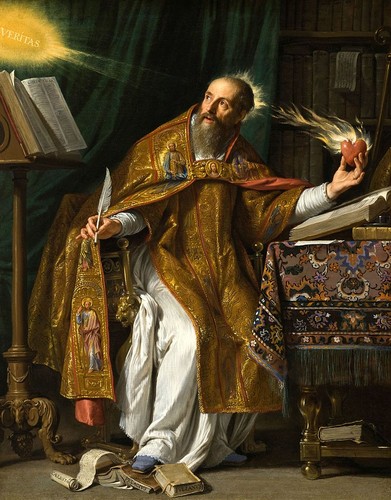
Augustine of Hippo
3 books on FireSoul · Latin Church Fathers, Patristic theology, Neoplatonism
Augustine of Hippo (354, 430) was a bishop, theologian, and philosopher from Roman North Africa whose doctrines of original sin, predestination, and grace became foundational to Western Christianity and whose works, including the Confessions, The City of God, and On the Trinity, have remained central to philosophy and theology for sixteen centuries. Born in Thagaste in Numidia, he passed through Manichaeism and Neoplatonism before his baptism by Ambrose in Milan in 387, then served as bishop of Hippo Regius from 395 until his death in 430 as the Vandals besieged the city. His output of over 113 books, 218 letters, and 500 sermons constitutes one of the largest surviving corpora from late antiquity.
Books by Augustine of Hippo



Biography
Born in the provincial town of Thagaste in Roman Numidia Cirtensis on 13 November 354, Aurelius Augustinus would spend the first half of his life fleeing toward secular glory and the second half explaining, in five million words or more, why that flight had been constitutively misdirected.
His father Patricius held land, paid taxes, and counted as a local notable without being prosperous. He wasn’t Christian, and his conversion came only near the end of his life, around the time Augustine was a teenager. Monica, his mother, was something else entirely: a Christian of deep and tactical conviction who enrolled her son as a catechumen in infancy and spent the following decades praying and manoeuvring with equal intensity for his soul. She understood, without apparent contradiction, that God’s ends and social advancement weren’t mutually exclusive. Rhetorical education was the ticket out of Souk Ahras and into Rome’s administrative class, and she wanted her son to have it. Patricius died around 370 CE. He leaves almost no trace in the sources, a man identified largely by his late conversion and his wife’s persistence.
What comes through clearly, even across sixteen centuries, is that Monica saw something in Augustine that she was determined not to waste. The household funded schooling first in Thagaste and then in Madauros, a nearby city with stronger rhetorical instruction. When money ran out, a wealthy patron named Romanianus bridged the gap. The boy was obviously exceptional, and people around him kept making that bet.
By his late teens he was in Carthage, second city of the Latin West, reading rhetoric and doing what brilliant provincial teenagers do when they arrive in large cosmopolitan cities without sufficient supervision. He fell into a relationship with a woman whose name he never recorded, but whom he clearly loved. She stayed with him for fifteen years. Their son, Adeodatus, which means “gift of God,” is probably the most honest piece of naming in the Confessions: whatever Augustine thought of the circumstances, he wasn’t ambiguous about the child. That book, written in 397 CE when Augustine was already bishop of Hippo and the relationship long behind him, would revisit those Carthage years with an analytical ferocity that has kept readers uncomfortable and fascinated in equal measure ever since.
Carthage was also where he found the Manichaeans. Around 373 CE, Augustine joined the sect founded by the prophet Mani, who had died in 254 CE, a movement with Persian roots that structured all of reality as a war between light and darkness, spirit and matter, a good principle and an evil one. For a rhetorician trained to demand rigorous argument, the appeal was real. The Manichaeans presented themselves as rationalists who didn’t require blind faith, who could explain the problem of evil philosophically, and who offered a community of educated men willing to argue about cosmological questions at serious length. The sect’s second tier of membership, the “hearers,” weren’t required to observe the strict celibacy demanded of its inner circle, which meant Augustine could remain sexually active without formal contradiction. He stayed for roughly nine years.
The disillusionment arrived in person. When Faustus of Milevis, the most celebrated Manichaean bishop, finally came to Carthage, Augustine had been storing up hard astronomical and philosophical questions for years. Faustus was charming. He wasn’t deep. He couldn’t answer the questions, and Augustine knew it. The framework that had seemed so sophisticated began to feel like elaborate evasion.
He’d been building an academic career alongside all of this. By his mid-twenties he was teaching rhetoric in Carthage, the same discipline that had raised him out of Thagaste. The students were disruptive and disappeared before paying their fees, so when he heard that Rome offered better conditions, he went. Monica tried to follow him to the harbour. He sailed without her, an act he would later describe with a guilt that reads entirely genuine. Rome’s students turned out to be disciplined about attending class and equally disciplined about avoiding payment. Then, in 384 CE, an appointment came through that changed everything: imperial professor of rhetoric in Milan, the most prestigious rhetoric post in the Latin West, at the court of the Western Emperor Valentinian II. He was thirty years old. He was expected to write and deliver panegyrics, tutor the children of powerful families, and circulate at court. He did all of it. He was also, at that moment, genuinely searching.
Milan gave him Ambrose.
The bishop of Milan, born around 339 CE, had been pulled from a governorship into episcopal office by popular acclamation, which was unusual enough to be memorable. He was formidably intelligent and politically capable, and he had absorbed the Neoplatonist tradition, particularly Plotinus, and was using it to read Scripture allegorically rather than reading it with the kind of flat literalism that had always repelled Augustine. Augustine went to hear him preach initially as a professional exercise, studying the technique. He found something more useful: a method for reading the Old Testament that didn’t require swallowing anthropomorphisms and apparent moral violence as though they were factual reports. The text had depths the surface didn’t reveal. Augustine began reading Plotinus and Porphyry in Latin translation. The encounter gave him a philosophical vocabulary for God as pure being, immaterial and unchangeable, beyond all categories of material substance, that Christianity as he’d previously encountered it hadn’t furnished.
He articulated what that encounter meant years later, in The City of God, Book VIII, where he argued that the Platonists “make the nearest approximation to Christian truth” of any philosophical school, because they recognised a supreme unchangeable Good above all created being, a Creator not only of the visible world but of every soul. He traced the line from Pythagoras of Samos and Thales of Miletus through Socrates, who had redirected philosophical inquiry from cosmology toward “the correction and regulation of manners,” and up to Plato as the great synthesiser of both traditions. This wasn’t casual name-dropping. Augustine was making a substantial claim: that Plato had partially seen what Christianity fully revealed, and that this partial vision was genuine knowledge. The Platonists had come close. But even their best thinking couldn’t secure blessedness in the life to come through the worship of multiple gods or the mediation of demons. That required something the philosophical schools couldn’t provide.
Monica caught up with him in Milan. She was negotiating a socially respectable marriage for him, and Augustine went along far enough to send his companion of fifteen years back to Africa, keeping Adeodatus with him. The prospective bride was too young for immediate marriage, and in the gap Augustine took up with another woman, which he recorded in the Confessions without softening. He was simultaneously reading Paul’s letter to the Romans and having what he described as a war inside himself between what he knew and what he kept choosing. The sentence from Book 8.7 that follows him everywhere, “Give me chastity and continence, but not just yet,” is self-criticism, yes. It’s also the most honest sentence a theologian ever wrote, and honesty at that register is why the Confessions has never gone out of print.
The resolution came in a Milan garden in the summer of 386 CE. Augustine heard a child’s voice, or believed he did, repeating the phrase tolle lege: take up and read. He opened Paul’s letter to the Romans, read chapter 13, verses 13 and 14, and later wrote that all uncertainty left him at once. Whether we call this mystical experience, psychological breakthrough, or both is probably the wrong question. The change was real and it didn’t reverse. He resigned his professorship. He and Adeodatus, along with his close companion Alypius and a small group of friends, withdrew to the country villa of a sympathiser at Cassiciacum near Milan. That winter he began writing: Contra Academicos, De Beata Vita, early philosophical dialogues that already show him weaving his Neoplatonist formation into his new Christian commitments. In April 387, Ambrose baptised him in Milan. He was thirty-two years old, or thirty-three by some reckoning that counts from the year of conversion rather than the baptism itself (some sources give 33).
Monica died shortly after. The group was at Ostia, the port town just outside Rome, waiting to sail back to Africa. She had witnessed the baptism. According to Augustine’s account in the Confessions, she told him she had nothing left to want from life. She was probably fifty-six. His account of her death is one of the strangest passages in the book: genuine grief, then an almost immediate self-reproach for feeling it, because he thought a proper Christian should be glad that a holy woman had gone to God. The grief came through anyway, which is both humanly comprehensible and, to anyone who’s read the rest of the Confessions, entirely characteristic.
He got back to Thagaste in 388 CE and set up a small quasi-monastic community in the family house, the kind of life he’d been imagining since Cassiciacum: prayer, Scripture, writing, conversation with serious friends. Adeodatus was part of it. He died young, within a few years of their return, a loss the Confessions absorbs in a single compressed sentence. Augustine stayed in Thagaste for three years, and then his life took a sharp turn he hadn’t planned.
In 391 CE, passing through the coastal city of Hippo Regius roughly fifty miles north of Thagaste, he was effectively seized by the local congregation and ordained a priest against any apparent prior intention. This wasn’t unusual in late antiquity. Consent was viewed as a bonus. Augustine wept at the ordination, which the congregation apparently took as humility. He explained later that he’d been weeping because he already knew what had just been put on him. The bishop of Hippo, Valerius, was a Greek speaker who found Latin difficult and was transparently relieved to have help. He allowed Augustine to preach, which was irregular for a mere priest in North African church practice, and let him build a monastery in the church garden.
Those early years at Hippo established the rhythm that would define the remaining four decades. Augustine preached; he wrote; he debated publicly. He held open disputations against the Manichaeans, including a direct confrontation with his former co-religionist Fortunatus in 392 CE. By 395, Megalius, Primate of Numidia, had consecrated him co-bishop, and when Valerius died he took sole charge of the diocese. He would hold it for thirty-five years.
The episcopate wasn’t the monastic retreat he’d been moving toward. Late-antique bishops weren’t only preachers and theologians; they were judges handling property disputes, the legal manumission of slaves, inheritance cases, and the full civil caseload of their communities. Augustine attended church councils in North Africa forty to fifty times over those three and a half decades and made the nine-day trip to Carthage roughly thirty times for regional bishops’ meetings. He maintained a correspondence that eventually produced 218 surviving letters reaching colleagues and correspondents across the Latin world, from Jerome in Bethlehem to Paulinus of Nola in Campania to bishops in Spain and Gaul. The final catalogue of his output runs to over 113 books, 218 letters, and 500 sermons; broader estimates push the total, including shorter works, considerably above a thousand distinct pieces. It is among the largest surviving bodies of writing from antiquity.
Three sustained controversies cut through that body of work and shaped the direction of Latin Christian theology for the millennium that followed.
The first was against his former community. Augustine knew Manichaean arguments from the inside, which made his refutations correspondingly precise. He didn’t simply dismiss the sect’s cosmological questions; he answered them. The central Manichaean question was genuine: if God made everything, where did evil come from? Augustine’s answer was philosophically exact. Evil isn’t a substance at all. It’s a privation, the absence of good, in the same way that disease and wounds are “nothing but the absence of health”: not something that arrives from outside, but a deficiency in what should be whole and functioning. God didn’t create evil because evil isn’t a created thing. It’s a defect in being. God, being supremely good, would never permit the existence of anything evil among His works if He were not so omnipotent and good that He can bring good even out of evil. The vices in the soul are privations of natural good; when they are cured, they don’t relocate elsewhere but cease to exist. He built this analysis from Plotinus’s treatment of matter as non-being, but anchored it in the Genesis creation account and gave it the theological weight it would carry for centuries.
The second controversy was against the Donatists, a North African schismatic church that had split from Rome roughly a century before Augustine’s birth over a specific historical question: were sacraments administered by priests who had collaborated with Roman persecutors during the Diocletianic persecution still valid? The Donatists said no. A compromised minister corrupts the sacrament. Augustine said the opposite, and his reasoning had consequences far beyond North Africa. The validity of a sacrament doesn’t depend on the moral character of the minister, because Christ is the true minister behind every visible one. The human intermediary doesn’t determine the grace; the rite does. This established what would later be codified as the principle of ex opere operato, which became the cornerstone of Catholic sacramental theology. The controversy also pushed Augustine toward increasingly coercive views on church unity. He endorsed the use of imperial force against the Donatists, reading Luke 14:23 (“compel them to come in”) as justification, a reading that later Christians would invoke in contexts Augustine couldn’t have anticipated and wouldn’t have endorsed. The practical conclusion came at the Council of Carthage in 411 CE, where Augustine and other Catholic bishops faced their Donatist counterparts before the imperial commissioner Marcellinus, and organised Donatism as a rival church effectively ended.
The third controversy, against Pelagius, produced the doctrine that has most durably marked Western Christianity. Pelagius was a British monk who’d come to Rome around 400 CE and was teaching that human beings can choose the good without special divine assistance. Grace helps; it isn’t strictly necessary. The faculties God gave us in creation, reason and free will among them, are sufficient if we use them properly. Augustine thought this was not just wrong but dangerously wrong, because it didn’t account for the depth of the damage. His own experience had shown him that the will can know what’s right and still choose otherwise, not occasionally, not accidentally, but habitually and structurally. He located that structural damage in Adam’s sin, transmitted not only by imitation but by inheritance, a spiritual corruption that bends the will at its root. We aren’t sinners because we sin; we sin because the capacity for sin is already constitutive of what we are. He drew part of this analysis from the pear-theft episode in Book 2 of the Confessions: as a teenager he and his friends stole pears from a neighbour’s garden, pears they didn’t want and threw to the pigs. Not hunger, not desire for the fruit. The pleasure of transgression itself. That gratuitousness pointed Augustine toward a will that isn’t merely weak but constitutively bent away from good. This is the doctrine of original sin as Western Christianity has understood it ever since.
From original sin followed predestination with logical necessity. If the will can’t turn toward God under its own power, then any turn that does occur must be the result of God’s prior initiative, grace given before any human merit earns it. And if God gives this grace to some and withholds it from others, there must be a prior divine election. Augustine spent the last years of his life pressing through the hardest implications of that position in works like On the Predestination of the Saints and On the Gift of Perseverance, both written around 428 to 429 CE. He didn’t flinch from them. He found them difficult, and said so plainly. But granting human beings the ability to earn or deserve salvation seemed to him to corrupt both the logic of grace and the humility that salvation requires. That metaphysics of guilt and dependence, which his biographers at World History Encyclopedia ground in the concept of reatus, the debt owed to God and compounded by the misuse of natural faculties, runs through everything he wrote after the conversion.
On the Trinity, composed over roughly two decades and brought to completion around 419 to 420 CE, is his most technically demanding achievement. The central problem was Arianism: if the Son is “begotten” and the Father is “unbegotten,” does that imply a difference in divine substance? The Arian answer was yes. Augustine’s answer was a careful reexamination of how predications about God work. Not all terms predicated of God operate at the level of substance. Some terms describe God in relation to Himself, like “good” or “great”; others describe Him in relation to something outside Himself, like “Father” in relation to the Son, or “Lord” in relation to the creature that serves. These relational predications don’t imply change in God, even when they appear to arise in time; God remains absolutely unchangeable in His own nature or essence. God is one substance, three relations. To make this intelligible, Augustine developed the psychological analogy: the Trinity can be contemplated in the structure of the human mind, in the triad of memory, understanding, and will. He intended this not as a proof but as an image, an intimation of the Creator’s inner life visible in the creature’s structure. And he was insistent that the image is inadequate. Even the Apostle Paul, the greatest, sees God “through a glass and in an enigma.” Latin Trinitarian theology for the next thousand years was built on that foundation.
Confessions, written around 397 CE, gets called the first autobiography in Western literary history, which is accurate as far as it goes but misses the organisational principle. The book is structured as a sustained address to God across thirteen books, narrating Augustine’s life from infancy through Monica’s death at Ostia, not to tell his own story but to demonstrate the pattern of a divine pursuit operating through experiences he didn’t understand as they were happening. The famous opening sentence establishes the key: “You have made us for yourself, and our heart is restless until it rests in you.” Every episode that follows is an instance of a soul fleeing and being overtaken. What keeps the book alive isn’t its theology, which readers can get in purer form elsewhere. It’s the fact that Augustine doesn’t resolve himself before writing. He’s genuinely puzzled by his own behaviour. He can’t explain the pears, or why he wept for his mother and then felt ashamed of the weeping, or why the will is so constitutionally divided against itself. He raises these questions honestly and doesn’t pretend to answers he doesn’t have. That is what has brought readers back for sixteen centuries.
De Doctrina Christiana, begun in 396 CE and finished around 426 CE, is a systematic guide to the interpretation and communication of Scripture. Augustine builds it on a theory of signs: all created things are signs pointing beyond themselves toward God, and the interpreter’s task is always to move from the exterior sign toward the interior referent, from the temporal good toward the eternal Good it shadows. He drew heavily on Ciceronian rhetoric and the broader tradition of Roman grammatical education, repurposing those intellectual tools for explicitly Christian ends. It became a foundational text for Christian hermeneutics and had a long practical life as a training manual for preachers.
The City of God came out of a political crisis. Alaric’s Visigoths sacked Rome in 410 CE, and the pagan critique was pointed: Rome had been under Christian emperors when it fell, and the old gods, had they been properly honoured, would have protected it. Augustine spent thirteen years, from 413 to 426 CE, building his reply, and the reply was a total reframing of what political order is for. Human communities, including Rome at its greatest, belong to what he called the City of Man, organised around earthly peace and oriented by self-love. The City of God is a different kind of community, not located in any particular state or ecclesiastical structure, but constituted by love of God. These two cities are intermingled in history. No human institution is purely one or the other, and the earthly city isn’t simply condemned: it has its proper good, which is peace, and Christians can and should participate in it. But it isn’t ultimate, and it won’t endure. When Augustine turned in Book VIII to the Platonists as his preferred interlocutors in natural theology, it was precisely because they “make the nearest approximation to Christian truth,” having genuinely recognised a supreme unchangeable Good above all created being. But even that genuine insight couldn’t secure blessedness in the life to come through the worship of multiple gods or the mediation of demons. For that, something beyond philosophy was required.
Augustine was, it bears saying, an African thinker. Numidia was his province, Latin his working language, Greek philosophy his intellectual formation, the Hebrew Bible the text he spent his life interpreting. The doctrines he produced, original sin, predestination, the invisible Church, the two cities, became characteristic possessions of Western Christianity. But the questions beneath those doctrines aren’t Western questions. Why does the will fail? What does grace cost? How does a creature relate to an uncreated source? Vedantic philosophy, Sufi theology, Buddhist phenomenology of mind: all of them press the same questions from different angles. Augustine’s answers are distinctively his, shaped by his moment, his language, his wounds. But the restlessness he diagnosed in the Confessions’ opening sentence isn’t a fifth-century North African phenomenon. It’s a human one. The particularity of his answers doesn’t make the questions parochial.
Martin Luther, born 1483, had been an Augustinian friar before he became a reformer. His insistence that salvation is by faith alone, not by works or sacramental merit, was essentially Augustinian predestinarianism pressed to conclusions Augustine himself had drawn back from. John Calvin then built a more rigorous predestinarianism on those same foundations. The Council of Trent, Rome’s counter-reforming response, also appealed to Augustine at every turn, which was awkward, since both sides had genuine textual warrant for doing so. The historian Paul Orosius came to Hippo around 414 CE seeking instruction from Augustine before travelling to Bethlehem to consult Jerome; his Historiarum Adversum Paganos, commissioned by Augustine himself, carried Augustinian ideas into later historiography. Prosper of Aquitaine, student and correspondent who survived his teacher by decades, became the vigorous defender of strict Augustinian predestinarianism in the Semi-Pelagian controversies that ran through the monasteries of southern Gaul well into the fifth century.
The implications of On the Trinity weren’t only theological. The claim that God is good without quality, great without quantity, a creator though He lack nothing, ruling but from no position, sustaining all things without having them, in His wholeness everywhere yet without place, eternal without time, making things that are changeable without change of Himself and without passion became, essentially verbatim, the standard formulation of divine simplicity in Latin scholasticism. Thomas Aquinas in the thirteenth century built his account of the divine nature directly on this Augustinian foundation and credited it explicitly in the Summa Theologiae. Anselm of Canterbury’s ontological argument in the eleventh century assumes an Augustinian framework for understanding God as the being than which nothing greater can be conceived. These aren’t decorative inheritances. They’re structural elements.
Augustine also left a theory of language. Signs, in his account, are things that point beyond themselves to something else. Words are signs of concepts. Created things are signs of their Creator. The interpreter of Scripture, or of the world, must always be moving from exterior sign to interior referent, from temporal goods to the eternal Good they shadow. This semiotic framework was enormously productive in the medieval period. It shaped allegorical biblical commentary and the broader problem of how human language can speak of God without collapsing God into human categories. And it’s worth remembering that Augustine didn’t arrive at these ideas as a theologian who happened to think about language. He was a rhetorician by training who had spent years professionally studying how persuasion works, how meaning is made, carried, and lost. That formation was never abandoned. It shows in everything he wrote.
His last months were spent under siege. The Vandals crossed from Spain into North Africa in 429 CE and moved east along the coast. By spring of 430 they were encamped outside the walls of Hippo. Augustine fell ill during the siege. He asked that the seven penitential psalms be written out on sheets of parchment and hung on the wall of his room so he could read them lying down. He spent his remaining days praying them. He died on 28 August 430, with the Vandal army still outside the walls. Hippo held for another fourteen months before it fell.
His remains were eventually transferred from Hippo to Sardinia, and then in the early eighth century to Pavia, where they rest today in the Basilica of San Pietro in Ciel d’Oro. That same church holds the tomb of Boethius, who died ninety years after Augustine and couldn’t have written the Consolation of Philosophy without him. Neither man knew the other. Neither man knew Pavia would be their common resting place. It is an accidental piece of the history of ideas, and an accurate one: two minds in a building neither chose, testifying to a continuity that outlasted every army that came after them.
Core Teachings
-
Privation theory of evil
Evil has no independent substance; it is a privation or defect of good, as disease is a defect of health. God did not create evil because evil is not a created thing but an absence.
-
Original sin and the wounded will
Adam’s sin is transmitted to all subsequent human beings not merely by imitation but by inheritance, corrupting the will at its root so that it cannot turn toward God under its own power. Humans are not sinners because they sin; they sin because they are already marked by sin.
-
Grace and predestination
Because the will is constitutively damaged, any movement toward God must originate in divine grace given prior to human merit. God elects some to salvation, and this election is not based on foreseen merit. Augustine developed this fully in On the Predestination of the Saints and On the Gift of Perseverance (428–429 CE).
-
Trinitarian theology and divine simplicity
In On the Trinity, Augustine argued that Father, Son, and Spirit are one substance in three relations, not three substances. Relational predications do not imply change in God’s essence. He developed the psychological analogy of memory, understanding, and will as an image of the Trinity in the human mind.
-
The two cities
In The City of God, Augustine distinguished between the City of Man, organised by earthly peace and self-love, and the City of God, constituted by love of God. These cities are intermingled in history; no human institution is purely one or the other, and the earthly city has its proper good in peace.
Lineage
- Teachers
-
- Ambrose of Milan
- Plotinus (via Latin translations)
- Cicero
- Students
-
- Paul Orosius
- Prosper of Aquitaine
- Monastery / Center
- Monastery at Hippo Regius (established in the church garden, c. 391 CE)
Quotes
“You have made us for yourself, and our heart is restless until it rests in you.”
“Give me chastity and continence, but not just yet.”
“God, being supremely good, would never permit the existence of anything evil among His works if He were not so omnipotent and good that He can bring good even out of evil.”
“These relational predications don't imply change in God, even when they seem to arise in time; God remains absolutely unchangeable in His own nature or essence.”
External Links
- Augustine of Hippo – World History Encyclopedia (academic)
- Saint Augustine of Hippo – Augustinian Order (foundation)
- On the Trinity, Book V – New Advent Catholic Encyclopedia (archive)
- The City of God, Book VIII – New Advent Catholic Encyclopedia (archive)
- Enchiridion, Chapter XIII – Christian Classics Ethereal Library (archive)
- Scholarly article on Augustine's doctrine of original sin – JSTOR (academic)
- Augustine – Encyclopaedia Britannica (academic)
- Augustine – Stanford Encyclopedia of Philosophy (academic)
- Augustine of Hippo – Catholic Encyclopedia (New Advent) (archive)
- Confessions – Internet Archive (public domain text) (archive)