
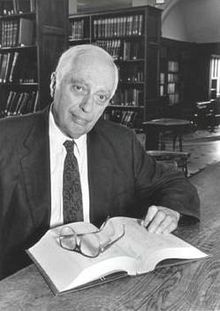
Bernard Lewis
1916 · 2 books on FireSoul
Bernard Lewis (1916, 2018) was a British-American historian and Princeton professor whose scholarship on Islam, the Middle East, and Muslim-Western relations made him one of the most influential and contested Orientalists of the twentieth century.
Books by Bernard Lewis


Biography
Bernard Lewis was a British-American historian whose scholarship on Islam and the Middle East shaped how the English-speaking world understood that region for more than half a century.
Born in London on 31 May 1916 to a middle-class British Jewish family, Lewis studied at the School of Oriental and African Studies before serving in the Royal Armoured Corps and Intelligence Corps during the Second World War, and briefly in the Foreign Office. He returned to SOAS after the war and was appointed to its new chair in Near and Middle Eastern history. He’d eventually cross the Atlantic for good, becoming Cleveland E. Dodge Professor Emeritus of Near Eastern Studies at Princeton University, a post he held for decades.
His books ranged across centuries and continents. The Jews of Islam examined the long, layered relationship between Jewish communities and Muslim societies. Political Words and Ideas in Islam traced how concepts of power and governance evolved in Islamic thought. He wrote the phrase “clash of civilisations” in a 1990 Atlantic Monthly essay before Samuel Huntington made it famous, and his 1976 Commentary piece “The Return of Islam” anticipated the Iranian revolution years before it happened. That kind of prescience won him enormous influence. By 2003 the Bush administration was consulting him on Iraq, though Lewis has said he recommended supporting internal revolution rather than invasion.
That influence came at a cost. The Palestinian scholar Edward Said called him a Zionist apologist and an Orientalist who demeaned Arabs and misrepresented Islam. Charles Tripp, another regional scholar, argued that Lewis’s later political involvement “reinforced Said’s argument about how forms of knowledge are produced to service power.” Lewis’s refusal to call the 1915 mass killing of Armenians a genocide drew sharp and sustained criticism from historians who rejected his framing as, in one summary, “ahistorical.”
There’s something genuinely difficult here. Lewis spent his career insisting that the Islamic world deserved serious, rigorous attention, not condescension. He wrote that assuming Arabs were incapable of democracy was “simply racist.” And yet his frameworks hardened over time, and he became a useful tool for people who wanted clean narratives about Islam and the West. The work and the use of the work aren’t the same thing, but they can’t be entirely separated either.
Lewis died on 19 May 2018, two weeks before his hundred and second birthday, in Voorhees Township, New Jersey.
External Links
- Bernard Lewis – Wikipedia (wikipedia)
- Bernard Lewis obituary – The Guardian (obituary)