
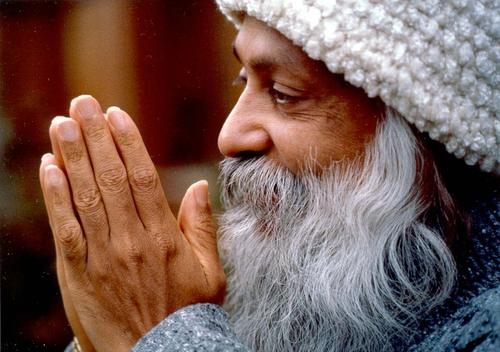
Bhagwan Rajneesh
1931–1990 · 1 book on FireSoul · Rajneesh movement, Neo-sannyas
Chandra Mohan Jain (1931, 1990), known as Bhagwan Shree Rajneesh and later Osho, was an Indian philosopher and mystic who founded the Rajneesh movement, developed dynamic meditation, and built a global following across six decades of extemporaneous teaching. His career moved from Indian academia through a Mumbai-based neo-sannyas movement to a vast Oregon commune that collapsed in criminal scandal, before he returned to Pune, where he died in 1990. His books, translated into sixty languages, and the Osho International Meditation Resort in Pune remain active presences in contemporary contemplative culture.
Books by Bhagwan Rajneesh

Biography
Chandra Mohan Jain, born on 11 December 1931 in the small village of Kuchwada in what is now Madhya Pradesh, India, became one of the twentieth century’s most provocative, polarising, and genuinely original spiritual teachers, known to the world first as Bhagwan Shree Rajneesh and, in the final year of his life, as Osho.
He wasn’t easy to hold in one hand. He was a trained philosopher who rejected philosophy as a path to the sacred. He was a guru who insisted that no guru could give you what you actually needed. He built one of the largest intentional communities in American history and then watched his closest disciples burn it down around him, sometimes literally. By the time he died in Pune on 19 January 1990, aged fifty-eight, he had accumulated ninety-three Rolls-Royces, survived a bioterror attack carried out in his name, been refused entry by more than twenty countries, and given hundreds of thousands of people a meditation practice they still use every morning. The contradictions weren’t incidental. They were, in a real sense, the point.
His childhood in Kuchwada was shaped by his maternal grandparents, with whom he lived until the age of seven after his parents moved to a larger town. The village had no electricity and no proper school. What it had, according to Rajneesh’s own later accounts, was silence and a river, and he spent his early years wandering both. He was, by his own description, a natural rebel: he refused to accept anything he hadn’t tested himself, a habit of mind that would define every phase of his public life. His family were Jains, and the Jain emphasis on non-dogmatism, on the idea that truth can’t be fully captured by any single viewpoint, left a visible mark on everything he later taught, even when he was most loudly rejecting organised religion.
At twenty-one, on 21 March 1953, he described experiencing a sudden and total spiritual awakening while sitting under a maulshree tree in Jabalpur’s Bhanvartal Garden. He said afterward that the event dissolved every boundary between himself and existence, that the separate “I” simply stopped. Whether one takes that claim at face value or not, something changed in him that night, and the change held for the rest of his life. Every major teaching he developed in the following decades, on witnessing, on ego dissolution, on the uselessness of belief as opposed to experience, flows directly from the account he gave of that night.
He went on to study philosophy at the University of Jabalpur, earning a B.A. in 1955, and completed an M.A. from the University of Saugar. He returned to Jabalpur as a lecturer in philosophy in 1957 and spent the next nine years teaching in the classroom by day while traveling across India on weekends and holidays, speaking in market squares, on temple steps, and at public debate tournaments where he was reportedly unbeaten. His university lectures were already drawing audiences who had little interest in academic philosophy. He was funny, encyclopedic in his references, and willing to say things that conventional teachers of every tradition refused to say. He criticised Mahatma Gandhi’s romanticism about poverty and village life. He mocked institutional Hinduism, Islam, and Christianity in equal measure. He said that sex, joy, and laughter were not obstacles to enlightenment but its natural expressions. The lecture halls at Jabalpur weren’t built for that kind of talk, and they kept filling up anyway.
In 1966 he resigned from the university and became a full-time teacher of meditation. It was a clean break: no academic title, no institutional affiliation, no salary. By this point he had absorbed and begun commenting on a staggering breadth of sources: Gautama Buddha, Lao Tzu, George Gurdjieff, Jiddu Krishnamurti, Meister Eckhart, the Sufi poets Rumi and Kabir, the Zen masters, Hassidic teachers, the Greek pre-Socratics, and Sigmund Freud. His discourses weren’t comparative religion in the academic sense. They were living commentary, delivered extemporaneously to audiences who sat with him for hours at a time, and they generated the manuscripts that would eventually become hundreds of published books. The Buddha, The Man Who Loved Seagulls, and The God Conspiracy all grew out of this era of sustained oral teaching. None of them reads like a treatise. They read like a very quick, very wide-awake mind talking directly to you, without notes, without deference to any single tradition, and without much patience for people who want their mysticism tidy.
By 1970 he was based in Mumbai, initiating his first disciples into what he called neo-sannyas. The traditional Indian sannyasi renounced the world and owned nothing. Rajneesh’s neo-sannyasins wore ochre robes, carried a mala of 108 wooden beads bearing his photograph, took new Sanskrit names, and were explicitly encouraged to keep their jobs, their relationships, and their appetites. What they were asked to renounce wasn’t pleasure but attachment to it, and the distinction mattered enormously to him. He thought the Indian tradition of asceticism had produced miserable saints, and he wasn’t interested in producing more of them. In a 1974 manifesto for his neo-sannyasins, he detailed the basic principles: each person could find their own way to spiritual enlightenment; he wanted to replace the secular, isolated lifestyle of the modern city with a communal and spiritual one; and he frowned on the institution of marriage as a substitute for genuine love, encouraging his followers instead to live by what he called the principle of free love.
The first Westerners arrived in significant numbers during this Mumbai period. They were therapists, artists, former hippies, and people who’d spent years working their way east through Goa and Kathmandu and ended up, somehow, in a rented apartment in Pedder Road listening to a bearded Indian philosopher tell them their guilt about desire was the only thing standing between them and liberation. Among those early Western arrivals were practitioners trained in the methods of the Human Potential Movement: encounter group facilitators, gestalt therapists, practitioners of bioenergetics and primal therapy. Rajneesh absorbed what they brought and folded it into his teaching, which was unusual for an Indian spiritual teacher of his era and which attracted precisely the people who’d found Western psychotherapy and Eastern meditation each, alone, insufficient.
In 1974 he relocated to Pune, establishing an ashram in the Koregaon Park neighbourhood that would become one of the most visited spiritual sites in Asia. The Pune ashram’s signature contribution to contemplative practice was dynamic meditation, a technique Rajneesh had been refining since the late 1960s. It runs in five stages: ten minutes of rapid, chaotic breathing through the nose; ten minutes of catharsis, in which participants are encouraged to express whatever arises physically and vocally without restraint; ten minutes of jumping with arms raised while repeating the mantra “Hoo,” intended to drive energy upward through the body; fifteen minutes of sudden, absolute stillness on the instruction “Stop!”; and a final fifteen minutes of silent celebration and dance. The logic behind the method is that most people carry so much suppressed emotional material that conventional seated meditation can’t reach it. Dynamic meditation aims to exhaust the nervous system and shock the mind into a gap, a moment of pure witnessing, before the habitual self can reassert itself. Rajneesh considered this gap, however brief, to be the actual point of the entire process.
The ashram also ran encounter groups, gestalt therapy sessions, bioenergetics workshops, and primal therapy intensives, an integration of Western therapeutic methods into an Eastern spiritual framework that had no real precedent in 1974. At its height in the late 1970s, the Pune ashram was drawing tens of thousands of visitors annually from Europe, North America, and Australia. It also drew the opposition of the government of Morarji Desai and the ruling Janata Party, which curtailed the ashram’s expansion and levied a back-tax claim estimated at five million dollars. Then, in July 1988, back in Pune after the Oregon years, Rajneesh introduced a further technique called “The Mystic Rose”: a three-week group process involving one week of three hours daily of laughter, one week of three hours daily of weeping, and one week of witnessing. He described it as the most significant new meditation method since Gautama Buddha. That’s the kind of claim that’s easy to dismiss and harder to refute if you’ve done the process, which tens of thousands of people subsequently did.
Rajneesh’s commentary ranged so widely, across Buddhism, Sufism, Taoism, Tantra, Zen, Hassidic Judaism, and the Christian mystical lineage from Eckhart to Francis of Assisi, that it could seem like eclecticism for its own sake. It wasn’t, or at least it wasn’t only that. What he was doing, consistently, across all the traditions he raided, was extracting the experiential core and discarding the institutional husk. He didn’t think the Sermon on the Mount and the Zen koans were saying different things. He thought they were saying the same thing badly translated by organisations with an interest in keeping it obscure. Whether he was right isn’t a question anyone can settle, but it’s a serious question, and the fact that he asked it in front of hundreds of thousands of people across four decades makes him a serious figure, whatever else he also was.
That’s the part that gets lost when the conversation moves too quickly to Oregon. We tend to remember him for the scandal, but the teaching is where the real argument lives.
He was, nevertheless, hard to defend as an institutional leader. He told his followers regularly that devotion to him was itself an obstacle if it replaced their own inner work. He said that all organised religions, including any organisation that might grow up around him, were enemies of the spirit. He meant it, and he built the organisation anyway, and he turned out to be right about both things simultaneously. The tension became impossible to ignore when, in 1981, the movement relocated its focus to the United States and bought a more than 64,000-acre ranch in Wasco County, Oregon. The ranch was in dry, remote country near the small town of Antelope, and what the movement built on it was, by any measure, extraordinary. By 1982, Rajneeshpuram was incorporated as its own city. It had a fire department, a police department, an airstrip, restaurants, a shopping mall, a public transport system, and its own World Festival, which began in 1982 and drew an estimated 15,000 attendees in 1984, who spent close to ten million dollars during their stay.
Rajneesh himself had by this point entered a long period of near-public silence, leaving day-to-day administration entirely in the hands of his personal secretary, Ma Anand Sheela. Sheela was efficient, intensely loyal, and willing to do things Rajneesh later claimed he hadn’t authorised and didn’t know about. The movement also, by this stage, had generated millions of dollars through business enterprises, investments, and donations, and operated on what Britannica describes as explicitly corporate principles. Rajneesh’s collection of Rolls-Royces grew, by various accounts, to ninety-three vehicles. His followers bought them for him one by one, as a kind of ritual gift. He drove past them in one each day; they lined the road. It was, depending on your perspective, a teaching on non-attachment to luxury or the most lavish counter-argument to non-attachment ever assembled.
The conflict with local residents escalated quickly. The ranch had been zoned for agriculture, and zoning rules allowed only six residents. The movement began buying property in Antelope itself, and Rajneeshees became citizens in sufficient numbers to take control of the Antelope city council and vote to rename the town Rajneesh. Local residents, mostly Christian conservatives, sought to disincorporate Antelope, but the vote failed. Tensions between the two communities moved well beyond political dispute.
In 1984, members of the movement’s inner circle contaminated salad bars at ten restaurants in The Dalles, Oregon, with salmonella bacteria, sickening 751 people in what remains the largest bioterror attack in American history. The objective was to incapacitate enough voters to swing a Wasco County election in favour of Rajneeshee candidates. It didn’t work. Ma Anand Sheela and another senior figure, Ma Anand Puja, were later convicted and served prison time. Rajneesh publicly accused Sheela of running a “fascist” operation behind his back. Critics pointed out, not unreasonably, that he’d shown little interest in oversight during the years it was running. He was also charged with a wider range of felonies, including arson and attempted murder, by federal investigators, though the immigration fraud charge was ultimately what stuck.
He was apprehended in 1985 at a North Carolina airport while attempting to leave the country, arrested, and subsequently pleaded guilty to immigration fraud. He was deported. What followed was a year-long odyssey by private jet as country after country refused him entry: twenty-one nations in total. Greece admitted him briefly. Uruguay did too, for a time. He was, as one account put it, essentially living in his private jet, unwanted by most of the world. Eventually he returned to the Pune ashram, which reopened and rebuilt its membership to 15,000 within a few years. Rajneeshpuram, back in Oregon, became a ghost town.
He had called himself, famously, a “spiritually incorrect mystic,” a line that gives the posthumous memoir Autobiography of a Spiritually Incorrect Mystic its title. The phrase is precise in ways he probably intended and in ways he probably didn’t. He said outrageous things about euthanasia, about Hitler, about marriage, about democracy, some of which were calculated provocations and some of which weren’t. He also said, at his best, things about the ego, about the mechanics of meditation, and about the damage that organised religion does to the individual spirit that haven’t been said more clearly by anyone else in the twentieth century. Both things are true, and it’s a mistake to let either cancel the other.
In 1989 he adopted the name Osho, a term he connected to William James’s word “oceanic,” carrying the sense of dissolving into the whole. It was also, he acknowledged, a traditional Japanese honorific for beloved teachers. The renaming was his last major reinvention: a shedding of the Bhagwan title, meaning “blessed one,” that had attracted so much mockery and legal scrutiny, and a reaching toward something older and quieter, more Buddhist in its register. It suited the man he seemed to be becoming in his final year: less combative, more absorbed in the daily work of the ashram and in introducing new techniques like The Mystic Rose to the practitioners who had stayed with him through everything. His health had been declining for years. His followers alleged that he had been poisoned with thallium during his period of American detention, a claim the United States government denied. He also had diabetes. He didn’t have long to inhabit the new name.
He died in Pune on 19 January 1990, surrounded by the disciples who’d remained, in the ashram in Koregaon Park where his public work had first found its shape. His books have since been translated into sixty languages and have sold tens of millions of copies. The Osho International Meditation Resort in Koregaon Park, with its black marble auditorium and reflecting pool, continues to draw visitors from across the world. The movement had an estimated 750 centres in more than sixty countries by the early twenty-first century. “Be a loving person rather than in a love relationship,” he once said, “because relationships happen one day and disappear another day.” It’s the kind of line that sounds like a fortune cookie until you sit with it for a few years. He made it back, after everything, to Pune, and he died there.
Core Teachings
-
Dynamic Meditation
A five-stage active meditation technique involving chaotic breathing, cathartic expression, mantra repetition, sudden stillness, and silent celebration, designed to exhaust suppressed emotional material so that a moment of pure witnessing can arise.
-
Neo-Sannyas and Engaged Non-Attachment
A reinterpretation of the traditional Indian renunciate life: disciples kept their jobs, relationships, and pleasures, but were taught to remain inwardly unattached to outcomes and desires rather than practicing external asceticism.
-
Anti-Dogmatic Spirituality
Rajneesh taught that genuine spiritual experience cannot be organised into any single belief system; he drew equally from Buddhism, Sufism, Taoism, Zen, Tantra, and Christian mysticism, treating each as an experiential rather than doctrinal resource.
-
The Mystic Rose
A three-week group meditation process introduced in July 1988 comprising one week of extended daily laughter, one week of extended daily weeping, and one week of silent witnessing. Rajneesh described it as the most significant new meditation technique since Gautama Buddha.
-
Integration of Western Therapy and Eastern Meditation
From the mid-1970s Rajneesh incorporated encounter groups, gestalt therapy, bioenergetics, and primal therapy into the ashram programme, creating a framework for seekers who found Western psychotherapy and Eastern meditation each insufficient alone.
Lineage
- Monastery / Center
- Osho International Meditation Resort, Koregaon Park, Pune, India
Quotes
“Be a loving person rather than in a love relationship—because relationships happen one day and disappear another day.”
“If you dance in life, then death will also be a dance!”
External Links
- Rajneesh – Wikipedia (wikipedia)
- Bhagwan Shree Rajneesh – Encyclopaedia Britannica (academic)
- Rajneesh Movement – Encyclopaedia Britannica (academic)
- Osho Biography – OshoWorld (official_site)
- Autobiography of a Spiritually Incorrect Mystic – Goodreads (publisher)
- I Charged My Sexual Energies at the Osho Meditation Resort – VICE (interview)