
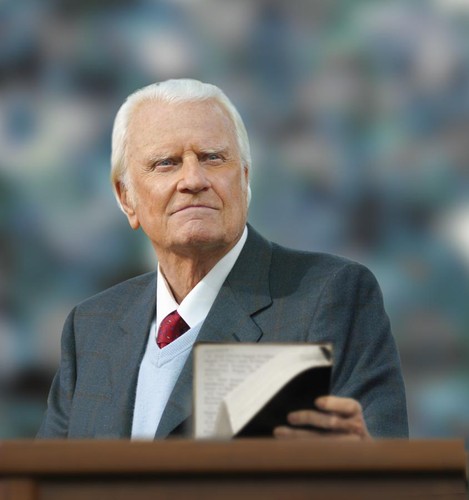
Billy Graham
1918–2018 · 2 books on FireSoul · Bob Jones College, Florida Bible Institute, Wheaton College
William Franklin Graham Jr. (1918, 2018) was a Southern Baptist evangelist who preached in person to more people than any Christian minister in recorded history, conducting large-scale crusades across six continents for nearly six decades. He served as unofficial spiritual adviser to eleven American presidents while also building bridges across denominational, racial, and national lines that surprised both allies and critics. His legacy includes both landmark acts of racial integration in the 1950s and the moral complications of his long proximity to political power.
Books by Billy Graham


Biography
William Franklin Graham Jr. preached to more people in person than any Christian evangelist in recorded history, a Southern Baptist minister from rural North Carolina whose six decades of stadium campaigns across six continents made him the unofficial chaplain to eleven American presidents.
His adolescence was ordinary by the standards of the Carolina Piedmont, and nothing in it pointed toward global reach. A local revival changed that. At sixteen, he walked forward at a meeting led by the itinerant preacher Mordecai Ham, and that decision reorganized the rest of his life. He enrolled at Bob Jones College in 1936, found it too constrictive, and soon transferred to the Florida Bible Institute near Tampa, where street corners and small local churches became his first pulpits. His undergraduate degree came from Wheaton College in Illinois in 1943. That small evangelical school west of Chicago would stay the institutional center of his world; the Billy Graham Center still stands on its campus, and it was in those years that he met Ruth Bell, who would work alongside him for more than sixty years.
Ordained as a Southern Baptist minister, he held a brief pastoral role at a small Illinois church. But the local pulpit couldn’t keep him. His “crusades” began in 1947: large-scale evangelistic campaigns that continued with only short gaps for nearly six decades. The national breakthrough came in Los Angeles in the autumn of 1949, eight consecutive weeks of nightly services in a circus tent at Washington and Hill streets. Newspaper magnate William Randolph Hearst, by then a committed reactionary who had spent parts of the 1930s promoting fascist causes in his papers, ordered his editors to cover and actively boost the young preacher. The coverage turned a regional revival into national news. Graham was thirty-one, tall and lean, with what his early biographer William Martin described as a head built for granite and hands scaled for a much larger body.
Out of Los Angeles came a template he’d sharpen across the next half-century. Every crusade had the same bones: a large venue, a massed choir, deliberately paced music, a long sermon at high volume, and an altar call, an invitation to walk to the front as a public declaration of faith. He called those who responded “inquirers” rather than converts, a distinction he cared about. Altar calls weren’t his invention; they ran back through Billy Sunday, Dwight L. Moody, and Charles Finney. But Graham made the format precise, portable, and reproducible. It worked in Madison Square Garden, in South American football stadiums, and in open fields across sub-Saharan Africa. His radio program Hour of Decision, launched in November 1950, carried that structure into living rooms across the country and ran through 1954 as one of the most-heard religious broadcasts in America. Television extended the reach further. Over six decades, Graham’s own organization estimates these combined broadcasts reached more than 210 million people across 185 countries and territories.
That number is worth sitting with for a moment. No graduate degree in theology. No established denomination fully behind him at the start. No inherited office. And yet more ears consistently heard his message than those of almost any other figure of the twentieth century. There’s a pattern to this across centuries and traditions: teachers whose authority comes not from institutions but from accumulated presence on the road, from showing up. Wesley in the English countryside, Sufi teachers crossing Central Asia, the wandering monks who moved through Tang dynasty China. Graham was thoroughly American and thoroughly Protestant, but the form he inhabited was older than either. That’s not to flatten the differences; it’s to say that when a tradition produces something this durable, it’s usually touching something prior to itself.
His core message changed very little across the decades. Graham taught that sin breaks the relationship between people and God, and that only sincere repentance combined with personal acceptance of Jesus Christ as savior restores it. The consistency was both the engine of his reach and the chief complaint of his critics. Reinhold Niebuhr, then the most prominent Protestant theologian in America and a professor at Union Theological Seminary in New York, wrote in the July 1957 issue of Life that mass evangelism’s success required oversimplifying every issue, and that Graham’s version offered fewer nuances than the tradition had ever before provided. His altar card, Niebuhr wrote, was a miracle of regeneration offered at a painless price, a bargain with the holy. When Graham sought a meeting to discuss it, Niebuhr refused. The Yale Daily News, reviewing his New Haven visit that February, found his insights “banal” and his delivery “embarrassingly overdramatic.” These were establishment verdicts. They stung. They didn’t stop him.
There was no shortage of critics. As early as 1952, the British Council of Churches declined to join the invitation that brought him to London, and when he arrived in 1954, at least one British newspaper compared him to a religious demagogue. During a 1956 trip to India, Graham’s suggestion that the U.S. government present Prime Minister Jawaharlal Nehru with a “white air-conditioned Cadillac” drew ridicule from Christian Century, whose editors concluded he hadn’t the faintest idea what was actually happening in the world. A Filipino newspaper likened him to a religious Liberace trying to sell American friendship the way the United States sold toothpaste. The scholarly biographer William G. McLoughlin, writing in 1959, acknowledged Graham as a typical revival figure serving people in a state of confusion, and predicted, cautiously, that his decline was probably just a matter of time. McLoughlin was wrong. When Graham preached a single service in Seoul, South Korea in 1973, roughly half a million people attended, reportedly the largest crowd ever gathered at a single religious event up to that point. Some Korean pastors still told him he hadn’t packed enough theology into his messages. He kept preaching as he always had.
The 1957 New York crusade, sixteen weeks at Madison Square Garden, was both the pivot of his career and his most public statement on race. In the early 1950s he had already begun ordering the physical ropes removed that divided Black and white sections at his Southern events. According to one account, when an usher at a Southern crusade refused the order and resigned on the spot, Graham took the rope down himself. By 1953, integrated seating was a nonnegotiable condition of every crusade, a full decade before the Civil Rights Act of 1964. For the New York campaign, associate evangelist Howard Jones advised him to go where Black New Yorkers actually gathered rather than wait for them to come to him. Graham visited two large Black churches directly, one in Harlem and one in Brooklyn. Their congregations came to Madison Square Garden. Jones described what followed as the beginning of a real shift in the racial composition of those enormous crowds, a visible browning and coloring of the audience.
On July 18, 1957, Martin Luther King Jr. joined Graham on the Madison Square Garden platform. White America hadn’t yet fully absorbed who King was or what he was building; his reputation at that moment rested largely within Black communities. Graham received threatening letters from white attendees who objected. He didn’t waver. Bernice King later said that her father and Graham together on that platform sent a message with particular force in the South, where an integrated stage was itself a provocation. The friendship continued after that night. In 1963, when King was imprisoned in Birmingham, Alabama, during the campaign that produced the Letter from Birmingham Jail, Graham helped arrange his bail. When King was assassinated in April 1968, Graham called it publicly “one of the greatest shocks of my entire life.”
He wasn’t a march leader and didn’t claim to be. His associate Ralph Bell put it plainly: Graham’s calling was proclamation, and he believed that changed hearts were the necessary foundation under any lasting social transformation. After the Civil Rights Act of 1964 passed, Senator Hubert Humphrey sought Graham’s help in making the law live rather than remain on paper, pointing at his own chest and telling Graham that real implementation had to come from there, from changed people. The insistence on integration extended internationally. South African invitations were refused repeatedly until 1973, when authorities finally agreed to permit a fully integrated gathering. Graham preached there that year to a mixed audience and declared that Christianity wasn’t the property of any one people or race. Apartheid itself didn’t fall until the 1990s, but South African newspapers covered his message closely enough that it registered culturally. He later wrote letters of support to Nelson Mandela during Mandela’s years in prison, and after Mandela’s election as president in 1994, issued a public statement in his support.
His relationship with the American presidency was simultaneously his greatest amplifier and his deepest professional vulnerability. The first meeting with a sitting president came in July 1950, when he visited Harry Truman at the White House. What followed was a mistake he spent decades describing as formative: he stood on the White House lawn and talked freely with journalists about the private meeting, even demonstrating for photographers the prayer posture he’d used with Truman. Truman, furious, called him “counterfeit.” They eventually made amends, and Graham learned to treat presidential conversations as confidences. He grew close to Eisenhower, Lyndon Johnson, and Nixon, his bond with Johnson especially personal and deep. The Nixon friendship proved the most costly. His visible support during the early 1970s, including through Watergate, damaged him significantly. When the White House tapes were released, they captured Graham in private conversation using antisemitic language he later publicly repudiated and apologized for. The episode became one of the defining moral complications of his record and a persistent reference point for critics who argued that proximity to power had bent his judgment.
He delivered the invocation and benediction at Bill Clinton’s inauguration in January 1993, a continuation of his practice as de facto chaplain of the presidency across party lines. The New York Times noted that both Clinton and Graham were Southern Baptists. His ecumenical reach extended into territory that made his evangelical base uncomfortable, particularly his gradual construction of working relationships with American Catholics. Before his ministry got underway in the 1940s, Protestant evangelicals and Catholics in the United States had regarded each other with open suspicion, near-hostility in many communities. Graham built across that divide anyway, and eventually encouraged Catholic inquirers at his crusades to return to their own parishes rather than join evangelical congregations. He also persuaded his longtime friend Robert Schuller to launch his own television ministry, a conversation that eventually produced the Crystal Cathedral in Garden Grove, California. Historian Grant Wacker, in his biography America’s Pastor, argues that Graham’s ecumenism was among the most consequential and underappreciated parts of his work.
It cost him with parts of his base. He kept doing it.
He also encouraged mainline Protestant converts to stay within or return to their own denominations rather than defect to evangelical churches. It was a consistent practice that made him a complicated figure: he was building an audience larger than any single tradition could claim, and he clearly understood it.
Graham’s bibliography runs to more than thirty titles. His autobiography, Just as I Am, appeared in 1997 at 760 pages. Columbia University’s Andrew Delbanco, reviewing it, called him the “Elvis of the evangelicals,” found the prose monotonous, and described its humor as largely unwitting. The book sold widely regardless, confirming Graham’s status as one of the most recognized religious figures on earth. Later books addressed aging and mortality with increasing directness. Nearing Home: Life, Faith and Finishing Well was published in 2011, when he was ninety-two. The Reason for My Hope: Salvation, out in 2013, returned to the evangelical core he’d been preaching since Los Angeles. Where I Am: Heaven, Eternity, and Our Life Beyond appeared in 2015, his last major book, focused entirely on his convictions about what comes after death. He was ninety-six when it was published. It reads like a man finishing a case he’d been building his whole life, without hedging and without retreat.
Formal recognition accumulated steadily. He received the Presidential Medal of Freedom in 1983, the Congressional Gold Medal in 1996, and was inducted into the National Religious Broadcasters Hall of Fame. The Gallup Organization placed him on its annual list of the ten most admired people in the world 55 times, including 49 consecutive years. No other individual has appeared on that list as often.
Active crusade ministry ended in 2005. Ruth Bell Graham died in June 2007 at their home in Montreat, North Carolina, after a long degenerative illness. She’d been his closest collaborator since their first meeting at Wheaton in the early 1940s, and her absence restructured his final decade. He stayed on in Montreat, increasingly confined, public appearances reduced to a handful. His son Franklin Graham took over leadership of the Billy Graham Evangelistic Association and moved it in directions sharply more partisan than his father had ever chosen publicly. The divergence became a subject of commentary in the elder Graham’s last years, though he kept his own counsel about it.
William Franklin Graham Jr. died at his home in Montreat, North Carolina, on February 21, 2018, at the age of ninety-nine. He was buried beside Ruth at the Billy Graham Library in Charlotte, on ground near the dairy farm where his life began.
Core Teachings
-
Salvation through personal decision
Graham taught that human sin breaks the relationship between people and God, and that only sincere repentance combined with personal acceptance of Jesus Christ as savior restores it. The altar call—a public walk to the front as a declaration of faith—was his signature method of inviting this decision.
-
Racial integration as Christian obligation
From the early 1950s Graham insisted on fully integrated audiences at all his crusades, removing segregation ropes himself when ushers refused, and making integration a nonnegotiable contract condition years before the Civil Rights Act of 1964.
-
Ecumenical outreach
Graham encouraged Catholic and mainline Protestant inquirers to return to their own churches rather than join evangelical congregations, building working relationships across traditions that many in his evangelical base found uncomfortable.
-
Gospel universalism
Graham consistently declared that Christianity was not the property of any one people, race, or nation, a message he preached explicitly during his 1973 South Africa crusades and throughout his international campaigns.
-
Heart transformation as basis for social change
Graham and his associates argued that lasting social transformation required changed individuals, and that proclamation of the Gospel was his specific calling within the broader work of justice—a position that drew both respect and criticism during the civil rights era.
Lineage
- Teachers
-
- Mordecai Ham
- Students
-
- Franklin Graham
- Howard Jones
- Ralph Bell
Quotes
“It comes as one of the greatest shocks of my entire life.”
“The Gospel is for everyone.”
External Links
- Billy Graham – Wikipedia (wikipedia)
- How Billy Graham Shaped American Catholicism – America Magazine (academic)
- Billy Graham – Encyclopaedia Britannica (academic)
- The Billy Pulpit: Graham's Career in the Mainline – Christian Century (archive)
- Why Billy Graham Was a Champion of the Civil Rights Movement – Crosswalk (archive)
- Graham to Give Invocation at Clinton Inauguration – New York Times (archive)
- Billy Graham Official Biography – BillyGraham.org (official_site)
- Billy Graham Awards and Honors – Believers Portal (archive)
- Awards and Recognition: The Ministry of Billy Graham – Biblia.work (archive)
- Hour of Decision – Wikipedia (wikipedia)