
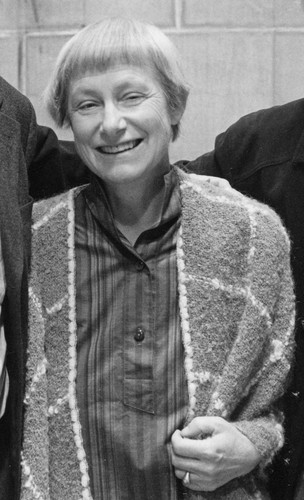
Dorothee Sölle
1929–2003 · 0 books on FireSoul · European Political Theology, Liberation Theology, Christian Mysticism, Feminist Theology
Dorothee Sölle (1929, 2003) was a German Lutheran theologian, poet, and political activist who developed political theology as a form of engaged praxis, arguing that faith without justice is theologically incoherent. Her most influential works include Suffering (1975), Political Theology (1974), and The Silent Cry (1997), and she taught at Union Theological Seminary in New York from 1975 to 1987. She’s remembered for her resistance to Christian accommodation with power, her cross-traditional theological openness, and her claim that ‘God has no other hands than ours.’
Biography
She was born Dorothee Nipperdey on 30 September 1929 in Cologne. Her father, Hans Carl Nipperdey, held the chair in labour law at Cologne and later became the first president of the West German Federal Labour Court, a post he occupied from 1954 to 1963. The household was quietly anti-Nazi, and she recalled being told as a child not to speak of it outside the home, that saying the wrong thing could put the family in a concentration camp. Months after the war ended she learned that her father carried one-quarter Jewish ancestry. That news, and the silence that had kept the family alive, and the guilt of being among those who survived, sat at the bottom of everything she wrote for the next fifty-five years. She wasn’t asking “Is theology possible after Auschwitz?” as an academic provocation. For Sölle, it was the question that made all other theological questions secondary.
Her doctorate came from the University of Cologne, where she worked across theology, philosophy, and literature, and her dissertation pursued the relationship between theological argument and poetic form. That combination was constitutive. She never adopted the sealed, category-respecting prose of most German systematic theology; her sentences could hold grief and argument at once, and they often did. She taught briefly in Aachen before returning to Cologne as a university lecturer. A permanent professorship in Germany was never offered to her. Her work was too transversal, her politics too visible, and she’d refused too many times to treat scholarly theology as a domain separate from political commitment. The University of Hamburg gave her an honorary professorship in 1994, which was both an honour and a pointed comment on what she’d been denied before it.
Several theological streams ran through her formation. Luther’s theologia crucis was central: the insistence that God is found not in power and triumph but in suffering and solidarity, in the cross rather than the throne. She began her thinking in critical conversation with Rudolf Bultmann, whose existential hermeneutics took personal experience seriously, and that drew her. But she broke with Bultmann on the question of what sin actually is. For Bultmann it was individual; for Sölle it was also structural, social, encoded in the arrangements of economic and political life. Any theology that couldn’t name structural sin was, whether it knew this or not, serving the status quo. Dietrich Bonhoeffer she held in a different kind of regard. She was fifteen years old when the Gestapo hanged him on 9 April 1945, and decades later she called him the one German theologian who “will lead us into the third millennium.” What she took from him wasn’t a method but a posture: that Christian existence has to be lived from the underside of history, not from its comfortable, well-housed centre. Much of her career was an attempt to inhabit that posture without merely imitating him.
She was one of three major figures in the European political theology movement that developed in the sixties and seventies, the other two being Jürgen Moltmann and Johannes Baptist Metz. All three had grown up in Nazi Germany and lived through the same aftermath: the ruins, the question of where God was in the extermination camps, the theological wreckage left by a Christianity that had largely accommodated itself to the regime. Moltmann was drafted into the German army at eighteen, saw combat, and spent time as a prisoner of war. Metz was conscripted at sixteen. Sölle didn’t serve, but she and they shared the same historical wound, and for all three, making theology after Auschwitz meant making theology in direct engagement with suffering and with the political conditions that produced it. Moltmann, like Sölle, was a Lutheran, and Luther’s theologia crucis ran through both their projects: the claim that God is encountered not in glory but in defeat, not in the places where power is concentrated but in the places where it fails or is withheld.
In 1968, Sölle and her husband Fulbert Steffensky launched the Politisches Nachtgebet in Cologne, a series of Sunday evening services held at the Antoniterkirche. The gatherings ran until 1972. They were ecumenical and deliberately confrontational, mixing prayer, performance, and political reflection on concrete events: the Soviet invasion of Czechoslovakia, the American war in Vietnam, Laos, and Cambodia, the authoritarian habits of both church and state. Established church leaders weren’t pleased, and their displeasure confirmed what Sölle had been arguing since her early critique of Bultmann: German Protestantism had spent too long keeping inner transformation and outer action safely apart from each other. The Politisches Nachtgebet was the counter-argument made weekly, made communal, made physical and public. She had been making versions of this argument since the mid-1960s, but now it had a time and a place and a congregation.
The Vietnam War turned her activism into something that couldn’t be managed within the conventions of academic life. She spoke publicly and repeatedly against the war, against the arms race, against what she named a “culture of death” that spent on weapons what it withheld from the poor. In 1983 she published two books in direct engagement with these questions: On War and Love and The Arms Race Kills Even Without War. These weren’t policy analyses. They were theological arguments, grounded in her conviction that the nuclear arsenals of the Cold War were not merely politically wrong but spiritually catastrophic, evidence of a collective failure of love. Marxist social analysis shaped her thinking about labour and alienation, but she never accepted Marx’s dismissal of religion. The estrangement of workers from the fruits and purpose of their labour was, for her, a wound to the soul as much as a structural fact. In Beyond Mere Dialogue: On Being Christian and Socialist (1978), she held class analysis and theology of the cross in the same frame, writing about sin and alienation alongside liberation and resurrection, refusing the usual protocols that kept these vocabularies apart.
Her two most widely cited books from the 1970s were Political Theology (1974) and Suffering (1975). Political theology, as she understood and practised it, was grounded in praxis: the theologian acts first, in engaged solidarity with those who suffer, and then reflects on that action rather than producing detached analysis from a safe distance. Suffering was the harder book, and arguably the more important one. She rejected what she called Christian masochism, the passive acceptance of suffering as God’s will, or as spiritually improving, and she was equally hostile to what she named Christian sadism: the theology in which God is omnipotent and deliberately sends suffering for some higher purpose. Both, she argued, are forms of theological complicity. God doesn’t impose suffering, and God isn’t indifferent to it. God suffers alongside us and is, in some sense, powerless before it. The sentence that attached itself to this argument and followed her for the rest of her life was: “God has no other hands than ours.” That’s not a figure of speech. It’s a demand. If God acts in history only through human agency, then inaction isn’t neutral; it’s a theological choice, with theological consequences. Suffering remains her most widely read book in English translation, and its argument still carries weight in ways that much academic theology from the same decade doesn’t.
In Beyond Mere Obedience she coined the term Christofascism to describe the merger of authoritarian politics with Christian language and imagery. The reaction to the word was louder than the reaction to the phenomenon it named, which told her something. And in To Work and To Love: A Theology of Creation (1984, co-written with Shirley Cloyes), she described the book as emerging from “my own struggle to agree with God and to learn to praise creation,” attempting to hold together the human being as creature, as worker, as one who is loved and one who must become a lover. It wasn’t a systematic treatment. It was a meditation that trusted its own tensions.
Between 1975 and 1987 she held a visiting professorship in systematic theology at Union Theological Seminary in New York City, spending roughly six months of each year there. Union in those decades was the most politically engaged seminary in the English-speaking world, and it suited her. She became involved with Democratic Socialists of America and its predecessor, the Democratic Socialist Organizing Committee, and she joined the DSA Religion and Socialism Commission. New York also brought her into sustained contact with currents of feminist theology and Black liberation theology that were developing independently of, and in some ways more radically than, the European political theology tradition. She didn’t treat these as auxiliary material. Among the students she worked with at Union was Ada María Isasi-Díaz, who went on to develop mujerista theology, a framework grounded in the lives and experiences of Hispanic women in the United States. The twelve years at Union weren’t a break from her European theological formation. They were a second one.
She never understood feminism as separate from her politics or her theology. Gender domination and ecological destruction were, for her, two expressions of the same logic, and she didn’t address one without implicating the other. In 1984 she published The Strength of the Weak: Toward a Christian Feminist Identity, and a decade later she wrote the narrative for Great Women in the Bible in Art and Literature (1994). Her engagement with Latin American liberation theology deepened through travel and through friendships with theologians working in base communities, and it found sustained expression in Stations of the Cross: A Latin American Pilgrimage (1993), which tried to bring that tradition into genuine dialogue with European political theology rather than simply describing it from the outside.
Something in her intellectual biography is worth pausing over. Sölle was a Northern European Lutheran who spent years learning from Catholic base communities in Central America, from Black liberation theologians in New York, from medieval women mystics who had been condemned by the Church they served. She didn’t treat any of these as quarries for her own prior conclusions. She let them alter her thinking. That kind of openness, the willingness to be changed rather than just informed, is considerably rarer in academic theology than the literature on cross-traditional dialogue would suggest. It’s part of why her work still moves across denominational and geographic lines in ways that most systematic theology, however rigorous, simply doesn’t. There’s something almost ecumenical about the shape of her mind: a genuine conviction that the Spirit wasn’t the property of any single tradition, and a bibliography that lived that conviction rather than just asserting it.
Her later work turned steadily toward mysticism, a development that surprised some readers but was continuous with everything that came before. The argument she’d made at the Politisches Nachtgebet, drawn from the Benedictine ora et labora and the Taizé principle of actio et contemplatio, was that struggle and contemplation can’t be separated. The Silent Cry: Mysticism and Resistance (1997, published in English translation in 2001) was where she worked this out most fully. Mysticism, she wrote there, was not a retreat from the world but “wide open eyes”, an encounter with God that opens outward, toward responsibility, not inward toward private consolation. She identified five sites of mystical experience: nature, eroticism, suffering, community, and joy. She wrote extensively about the medieval women mystics, and in particular about Marguerite Porete, burned at the stake in Paris in 1310 for teachings her examiners couldn’t tolerate. In Porete and others like her, Sölle found a tradition of direct, unmediated access to the divine that didn’t depend on ecclesiastical control. As a Lutheran, most of the Christian mystical tradition had been formally outside her inheritance. She pushed the door open anyway, and she was clear about why: “Wherever theology undergoes changes,” she wrote in The Silent Cry, “mysticism plays a part in it.”
Her autobiography, Against the Wind: Memoir of a Radical Christian (1999), set out her theological credo in compressed form: “I believe in God who created the world not ready made… but who desires the counter-arguments of the living and the alteration of every condition through our work, through our politics.” A God who desires counter-arguments isn’t a God who requires submission. It’s a God who is in some way completed by human resistance, by the refusal to accept that things must stay as they are. That theology was uncomfortable by design. But it gave her readers, especially those who’d grown disillusioned with a Christianity that had made its accommodations with wealth and with power, something actual to hold.
Her influence is clearer in names than in general claims about what she accomplished. The posthumous essay collection The Theology of Dorothee Soelle, edited by Sarah K. Pinnock and published by Trinity Press International in September 2003, was the first English-language volume of original essays devoted to her work. Its contributors included Rosemary Radford Ruether, Beverly Wildung Harrison, Carter Heyward, Luise Schottroff, and Andrea Bieler, among others. The spread of those contributors, across feminist theology, post-Holocaust thought, social ethics, liberation theology, maps almost exactly onto the range of questions Sölle had insisted on keeping together. The book was assembled and published five months after her death. She didn’t see it.
In the last years of her life she worked regularly with the Latin American music ensemble Grupo Sal, combining her spoken texts with their music in literary-musical evenings. Their final recording together, Das Lied der Erde singen in einer Welt der Gewalt (Singing the Song of the Earth in a World of Violence), captured her last public appearance with the group. Three of the six texts she contributed to it were previously unpublished. It’s one of the very last recordings of her voice, and a strange kind of document: a Northern European Lutheran theologian, at the end of her life, singing into the world with a Latin American ensemble, in a collaboration that wouldn’t have been imaginable from within the boundaries of any single tradition.
Her final book, Mystik des Todes, was published posthumously in 2003 by Kreuz Verlag in Stuttgart. It was unfinished. It took death as its subject, pressing the question of what the mystical tradition could say not just about suffering and resistance but about dissolution itself. She didn’t complete it.
Dorothee Sölle died on 27 April 2003 at a theological congress in Göppingen, Germany. German sources, including Zeit.de, give her age at death as 73; some English-language sources give 74. Born in September 1929 and dead in April 2003, she was 73. She died, characteristically, in the middle of a theological argument, at a congress, surrounded by people still working out what the gospel owed the world.
Core Teachings
-
Political Theology as Praxis
Sölle argued that authentic theology must begin with engaged social and political action rather than detached analysis. The theologian acts first, in solidarity with those who suffer, then reflects — a method she lived through the Politisches Nachtgebet and her anti-war activism.
-
Theology of Suffering
In Suffering (1975), Sölle rejected both passive Christian endurance of pain and the idea that God sends suffering for a higher purpose. God doesn’t cause suffering, she argued; God is powerless before it and suffers alongside us. Human beings are therefore God’s only hands in history.
-
Mysticism and Resistance
In The Silent Cry (1997), Sölle described mysticism not as withdrawal from the world but as ‘wide open eyes’ — an encounter with God that opens outward to responsibility. She identified five sites of mystical experience: nature, eroticism, suffering, community, and joy.
-
Feminist and Ecological Theology
Sölle saw gender domination and ecological destruction as two expressions of the same logic of domination, and she refused to address one without implicating the other. Her The Strength of the Weak (1984) developed a Christian feminist identity grounded in these linked concerns.
-
Christofascism and the Critique of Christian Fundamentalism
In Beyond Mere Obedience, Sölle coined the term ‘Christofascism’ to name the fusion of authoritarian political power with Christian language. The controversy the word generated confirmed her point: the naming provoked more reaction than the phenomenon it named.
Lineage
- Teachers
-
- Rudolf Bultmann
- Dietrich Bonhoeffer (formative influence)
- Luther's theologia crucis
- Students
-
- Ada María Isasi-Díaz
Quotes
“God has no other hands than ours.”
“I believe in God who created the world not ready made... but who desires the counter-arguments of the living and the alteration of every condition through our work, through our politics.”
“Wherever theology undergoes changes, mysticism plays a part in it.”
“Bonhoeffer is the one German theologian who will lead us into the third millennium.”
External Links
- Religious Socialism: Tribute to Dorothee Sölle (Fall 2003) (archive)
- OpenDemocracy: God Is Justice — The Social Spirituality of Dorothee Sölle (academic)
- Die Zeit: Obituary for Dorothee Sölle (2003) (obituary)
- Internet Archive: Political Theology (1974) (archive)
- Lived Theology: The Theology of Dorothee Soelle, ed. Sarah K. Pinnock (academic)
- Grupo Sal: Dorothee Sölle — Schule des Betens (archived) (archive)
- Academic review of Mystik des Todes (Karolinum) (academic)
- Sölle's own writing archived at Religious Socialism (interview)