
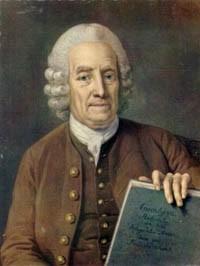
Emanuel Swedenborg
1688–1772 · 1 book on FireSoul · The New Church (Swedenborgianism), organized 1787, Bryn Athyn College of the New Church
Emanuel Swedenborg (1688, 1772) was a Swedish polymath who spent the first half of his career as a scientist, engineer, and mining official before a series of visions in 1743, 1744 redirected him toward theology. Over the last twenty-eight years of his life he produced eighteen published theological works, including Heaven and Hell (1758) and True Christian Religion (1771), which became the doctrinal foundation of the New Church denomination founded in 1787.
Books by Emanuel Swedenborg

Biography
He was born Emanuel Swedberg on January 29, 1688, in Stockholm, the son of Jesper Swedberg (1653, 1735), a Lutheran clergyman who rose to the bishopric of Skara and held pietistic convictions strong enough to get his own hymnbook condemned by church censors. Jesper Swedberg’s translation of the Bible was condemned alongside it. On his father’s side the family descended from mine-owning stock in the bergsfrälse tradition: early noble families whose wealth came from Sweden’s mining sector, with a patrilineal line running back to Olof Nilsson Stjärna of Stora Kopparberg. Theological seriousness and material comfort were both part of the household, and both left their mark.
Uppsala University granted him his philosophy degree in 1709. What followed was five years of roving. Between 1710 and 1715 he moved across England, the Netherlands, France, and Germany, picking up mathematics, astronomy, engraving, and instrument-making as he went. He wrote three volumes of poetry during these years and put descriptions of fourteen inventions to paper, including a submarine, an air pump, and a fixed-wing aircraft. His brother-in-law Erik Benzelius, a scholar well connected across European intellectual circles, helped open doors during this period, and according to Swedenborg’s own later account, Benzelius’s influence did much to orient his early appetite for natural science. But the curiosity itself was Swedenborg’s own. He wasn’t specializing; he was trying to understand how everything fit together, and he thought it did fit together, that a single coherent framework could contain physics, cosmology, the body, and the soul. That conviction never left him.
He was back in Sweden by 1715 and moved quickly. He founded Daedalus Hyperboreus, Sweden’s first scientific journal, and attached himself to Christopher Polhem (1668, 1751), the mechanical inventor and engineer whom King Karl XII had engaged on large infrastructure projects for the realm. The two men collaborated directly on engineering works for the Crown. Karl XII named Swedenborg Extraordinary Assessor of the Board of Mines in recognition of his contributions. Then Karl XII died at Fredrikshald in 1718, Sweden’s era as a great power closed, and the political climate shifted sharply against the old royal appointments. Queen Ulrika Eleonora (1688, 1741) ennobled him in 1719, and the family name changed from Swedberg to Swedenborg at that point, when the family was raised to the nobility and took a seat in the House of Nobles.
The salaried assessor appointment didn’t come through until 1724, after he’d spent 1720 on a further European trip specifically studying continental mining techniques. It was methodical, unglamorous work: seven men responsible for Swedish mining policy, inspecting operations for safety, assaying metals for quality, adjudicating commercial disputes, and setting prices. He held that position for twenty-three years. This is worth dwelling on. The man who would later produce a thousand-page spiritual cartography of the afterlife spent more than two full decades as a mining bureaucrat, and it wasn’t a sinecure: the Board of Mines shaped a central pillar of Sweden’s economy. He was offered the presidency of the Board in 1747 and declined it, resigning the post entirely to pursue what he’d come to regard as his real work.
The philosophical writing didn’t wait for the bureaucratic chapter to close. In 1734 he took a leave of absence from the Board and traveled to Leipzig to publish Opera philosophica et mineralia, a multi-volume work that included Principia rerum naturalium (The First Principles of Natural Things), his account of how the universe developed from a mathematical point through successive particle combinations. He was working consciously in Descartes’s wake, adapting a mechanistic cosmology while trying to push it further than Descartes had gone. His stated ambition went beyond cosmology from the start: the companion volume De infinito (1734) sets out a research program, in his own words, to “prove the immortality of the soul to the very senses themselves.” That wasn’t a pious flourish. It was an empirical commitment, and he intended to honor it through anatomy.
Anatomy was the next front. The Oeconomia regni animalis (The Economy of the Animal Soul’s Kingdom), published in 1740, 1741, attempted to locate the soul’s functional operations within the body’s physiological economy. He found it insufficient. He started again: three volumes of Regnum animale (The Animal Soul’s Kingdom) appeared in 1744, 1745 before he abandoned that project too. Not because the anatomical work had failed, but because something else had arrived and displaced it. Historians of neuroscience have returned to this anatomical writing with retrospective interest: his descriptions of the cerebral cortex and of the function of cerebrospinal fluid anticipated conclusions that instruments wouldn’t confirm for well over a century.
The crisis began during a publishing trip abroad in 1743, 1744. In a private journal he never prepared for publication, Swedenborg recorded a series of dreams that he didn’t just transcribe but interpreted. They amounted, in his reading, to a diagnosis of his own pride and arrogance. He prayed. He recorded seeking forgiveness and experiencing what he described as being held in the bosom of Christ. He documented physical and spiritual temptations that tormented him through nights and days. The sequence reached its climax over Easter weekend, on April 6, 1744: a vision he understood as a direct commission from Christ. Set aside the scientific project. Write down and publish the true inner meaning of scripture. The journal was discovered in 1859 and is now published as The Journal of Dreams. He was fifty-six years old when the vision came. He never wavered about what had happened.
He never wavered.
The theological works begin with Arcana coelestia (Secrets of Heaven), published between 1749 and 1756 in eight Latin volumes: a verse-by-verse spiritual exegesis of Genesis and Exodus, running to thousands of pages, each passage receiving both a literal sense and a continuous inner meaning that he claimed to derive not from prior commentaries but from direct spiritual perception. He published these volumes, like his other theological works from this period, anonymously; he maintained that anonymity for nearly twenty years and made no effort to gather a following during his lifetime. He’d told readers in De infinito what the goal was. Arcana coelestia was him executing it, at full length, with no shortcuts.
Heaven and its Wonders and Hell From Things Heard and Seen came out in 1758, first in Latin, and it’s the work most readers encounter first and the one that has stayed in print longest. An English edition was published by the Swedenborg Foundation in 1946. The architecture of the afterlife as he describes it is precise to a degree that reads almost like a surveyor’s report: heaven divided into two kingdoms and three levels, each level comprising innumerable societies, each society mirroring the structure of a human form, the whole of heaven together constituting what he calls the Grand Man. Angels aren’t a separate species; they’re people who have died and arrived in states that reflect the loves they carried through life. Hell is organized symmetrically by the varieties of self-love and love of the world. Passage between the two isn’t adjudicated by an external tribunal: “The Lord casts no one into Hell; the spirit casts himself down.” What you love is where you go. The mechanism is interior, not forensic.
The same work also introduced, to most readers, the doctrine of correspondences, which sits underneath all of his theological writing. Every natural thing corresponds to a spiritual reality: the physical world isn’t merely physical, it’s a language, and scripture’s literal text is only the surface layer of a continuous spiritual sense running beneath it. “There is a correspondence of all things of Heaven with all things of man,” he wrote, with man in turn corresponding to the natural world. He reported this not as inherited Neoplatonic theory, not as metaphor, but as observed fact. The phrase his later commentators returned to repeatedly was his own: “I have seen, I have heard and I have felt.” That insistence on empirical testimony, the same register in which he’d once described ore samples and planetary mechanics, is what distinguishes his mysticism from most of the Western tradition: he wasn’t making claims about the ineffable, he was filing a report.
These claims extended to positions that put him outside every standard denominational map. He said the Last Judgment had already occurred in 1757, the year before De Nova Hierosolyma et ejus doctrina coelesti (Concerning the New Jerusalem and its Heavenly Doctrine) appeared also in 1758 as a compact doctrinal summary. The New Jerusalem prophesied in the book of Revelation wasn’t a future event to be awaited; it had begun spiritually, and its doctrine was what he was now writing down. On the Trinity, he was unitarian in a specific sense: Father, Son, and Holy Spirit are three aspects of one Divine Person, the Lord Jesus Christ, not three persons of a single Godhead. This took him well outside Lutheran orthodoxy. But he wasn’t looking for an institutional home. He continued attending sessions of the Swedish House of Nobles, corresponded with scholars across Europe, and traveled regularly between Stockholm, Amsterdam, and London.
Something worth sitting with, for any reader who has come at this material from a different tradition entirely: these accounts of interior worlds organized by love, of post-mortem states that faithfully reflect the dispositions people carried through life, of a universe whose physical surface functions as a language pointing toward what it can’t contain by itself, turn up in more places than Swedenborg. A Buddhist reader of Heaven and Hell will find the cartography foreign but the mechanism recognizable. A reader who knows Ibn Arabi’s doctrine of the imaginal world will find the correspondence framework oddly familiar. Swedenborg hadn’t read Ibn Arabi, as far as anyone knows. That convergence isn’t proof of anything. But it’s the kind of thing that makes the usual category of “eccentric Swedish Protestant mystic” feel like a label that misses the actual size of the question he was working on.
Divine Providence, published in 1764, worked through the implications of correspondences for human freedom. God’s providence operates continuously through a creation where no will is compelled. Hell exists because some souls prefer it; God permits that preference because love can’t be coerced, and a coerced love wouldn’t be love. The argument is tight and strange and more coherent than most dismissals of it acknowledge. True Christian Religion (Vera Christiana Religio), published in 1771, was the last major work he saw through the press himself: a comprehensive systematics of more than a thousand pages, integrating everything from the earlier volumes into a single doctrinal structure. He published it himself and called himself in it a “Servant of the Lord Jesus Christ.” He was eighty-three. Drafts of other projects sat unfinished at his desk.
The influence outside denominational Swedenborgianism is harder to map but arguably more pervasive. William Blake read Swedenborg through the 1780s with an intensity visible in his annotated copies: alternately admiring and furious, he absorbed the doctrine of correspondences into his own symbolic system even as he attacked what he took to be Swedenborg’s spiritual self-satisfaction. Blake’s fourfold vision, his account of the spiritual senses, his sustained critique of “single vision and Newton’s sleep” are partly a decades-long argument with Swedenborg. Samuel Taylor Coleridge engaged him closely enough to leave extended records in his notebooks. Ralph Waldo Emerson gave him a full chapter in Representative Men (1850), called him a “colossal soul,” found the doctrine of correspondences generative, and found the man himself a little airless; the theology’s sheer bulk, Emerson wrote, was oppressive even to an admirer. Henry James Sr., father of the novelist Henry James and the psychologist William James, was a committed Swedenborgian, and his theology shaped the intellectual atmosphere of a household that produced two of the most consequential American minds of the century. Jorge Luis Borges wrote about Swedenborg directly and borrowed from him structurally, particularly in stories that hinge on elaborate hierarchies of the real and on the idea that imagination and spiritual vision are the same faculty.
The New Church, also known as Swedenborgianism, was formally organized in 1787, fifteen years after his death, by followers in England and Sweden who read his theological writings as direct divine revelation. It’s classified as a Restorationist denomination of Christianity. The movement spread through Britain, across Europe, and into North America across the nineteenth century. Within that tradition, a long-standing internal debate runs over which works carry full divine authority: some hold that only the texts Swedenborg personally saw through the press qualify; others regard the complete corpus, including posthumous manuscripts and working drafts, as equally reliable. It probably can’t be.
Academic reception remains genuinely complicated. Swedenborg gets cited in near-death experience research for the phenomenological specificity of his afterlife descriptions, usually with careful distancing from any endorsement of the claims themselves. Parapsychologists cite him for the three famous clairvoyance episodes reported in his later life, including the well-documented account of his describing, in Gothenburg in 1759, a fire that was burning at that moment in Stockholm, three hundred miles away. The report of this incident reached Immanuel Kant, who investigated it and couldn’t dismiss it, and then wrote about Swedenborg with a mixture of intellectual unease and scorn in Dreams of a Spirit-Seer (1766). The full corpus is available online through the New Christian Bible Study project, whose digital infrastructure runs back to the NewSearch software developed by the STAIRS project at Bryn Athyn College of the New Church during the 1980s and 1990s; the project launched publicly in 2013, making the complete Latin and English texts alongside collateral literature searchable by anyone with a browser. Bryn Athyn College, a Swedenborgian institution in Pennsylvania, is one of the main American centers for formal study of his work.
He died on March 29, 1772, in London, at eighty-four. True Christian Religion had come out the year before. He’d written what he set out to write. His body was eventually returned to Sweden and reinterred at Uppsala Cathedral in 1908, more than a century after his death, at the request of the Swedish state.
Core Teachings
-
Doctrine of Correspondences
Every element of the natural world corresponds to a spiritual reality; scripture’s literal text is the surface of a continuous inner spiritual meaning. Swedenborg presented this as empirical observation, not metaphor.
-
Structure of Heaven and Hell
Heaven is divided into two kingdoms and three levels, each comprising innumerable societies that mirror human form; hell is organized symmetrically by self-love and worldly love. Destination after death is determined by the loves a person cultivated during life, not by external judgment.
-
The Lord Casts No One into Hell
Swedenborg taught that God compels no one; souls cast themselves into hell by their own dominant loves. Divine providence works continuously through a creation where no will is coerced.
-
Unitarian Christology
Father, Son, and Holy Spirit are three aspects of one Divine Person, the Lord Jesus Christ, not three persons of a Godhead. This position placed Swedenborg outside Lutheran orthodoxy.
-
The Heavenly Doctrine and the New Jerusalem
Swedenborg held that the Last Judgment occurred spiritually in 1757 and that the New Jerusalem prophesied in Revelation had begun spiritually, its doctrine being what he was commissioned to write and publish.
Lineage
- Teachers
-
- Erik Benzelius (brother-in-law, early intellectual influence)
- Christopher Polhem (engineering mentor)
Quotes
“I have seen, I have heard and I have felt.”
“The Lord casts no one into Hell; the spirit casts himself down.”
“There is a correspondence of all things of Heaven with all things of man.”
External Links
- Emanuel Swedenborg – Wikipedia (wikipedia)
- Swedenborg, Emanuel – Encyclopedia.com (academic)
- Emanuel Swedenborg – Encyclopaedia Britannica (academic)
- Swedenborg: His Theology – Encyclopaedia Britannica (academic)
- Heaven and Hell (1758) – Swedenborg Digital Library (archive)
- New Christian Bible Study / HeavenlyDoctrines.org (official_site)
- Swedenborg the Man and His Work – Swedenborg Philosophy (foundation)
- Swedenborg Foundation (publisher)
- Bryn Athyn College of the New Church (foundation)
- Swedenborg – Dictionary.com entry and usage examples (archive)