
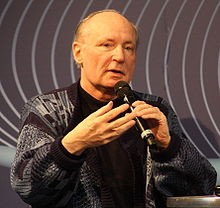
Eugen Drewermann
1940 · 0 books on FireSoul · Tiefenpsychologie (Depth Psychology), Neopsychoanalysis, Catholic moral theology
Eugen Drewermann (born 1940, Bergkamen) is a German theologian, psychotherapist, and peace activist who spent four decades arguing for a depth-psychological reading of Christian scripture and became the most publicly contested Catholic intellectual in postwar Germany. Stripped of his teaching and preaching licenses by Archbishop Degenhardt in 1991, 92 and suspended from the priesthood in March 1992, he formally left the Roman Catholic Church on his 65th birthday in 2005. His more than 80 volumes, translated into over a dozen languages, span biblical exegesis, psychology of religion, and political pacifism.
Biography
Eugen Drewermann is a German theologian, psychotherapist, and peace activist whose four-decade campaign to reread the Christian scriptures through the lens of depth psychology made him the most publicly contested Catholic intellectual in postwar Germany.
He was born on 20 June 1940 in Bergkamen, a mining town near Dortmund in the Ruhr. His family was mixed-confessional: his father Lutheran, his mother Catholic, a domestic arrangement that was ordinary enough in the Ruhr’s working-class communities and yet, for Drewermann, formative in a way that outlasted childhood. He sat inside two ways of reading the gospel from the beginning, and he never fully left either of them behind. The tension wasn’t resolved in his adult theology; it was deepened, turned into a method, and eventually turned against both traditions’ institutional certainties alike.
After completing his Abitur, he studied philosophy at the University of Münster, then theology in Paderborn. He was ordained as a Catholic priest in 1966. But the training that would most shape his mature thought came later: beginning in 1968, he pursued neopsychoanalysis in Göttingen, studying the tradition that runs from Freud and Jung through the object-relations schools and into the clinical practice that in Germany travelled under the label “Tiefenpsychologie.” He habilitated in Catholic theology in 1978 and from 1974 worked as assistant priest at the parish of St. George in Paderborn, while simultaneously practicing as a psychotherapist. The combination was unusual for a diocesan priest. It was also productive in ways that would eventually alarm Rome.
The central argument of Drewermann’s theology isn’t complicated to state, though it took more than 80 volumes to work out in full. Biblical texts aren’t historical records or literal accounts of supernatural events; they’re symbolic expressions of the human psyche’s deepest fears and longings. The virgin birth, the resurrection, the miracle stories in the gospels: read literally, they produce anxious believers trying to defend implausible propositions. Read symbolically, as the Alexandrian church fathers already understood them, they speak directly to what he calls the condition of Angst, the existential dread that he regards as the defining wound of modern human beings. Jesus, on Drewermann’s reading, isn’t primarily a doctrine; he’s a figure whose encounters with frightened, marginalised people show what it looks like when fear dissolves into trust. As he put it in a lecture event at the Eifel Kulturtage in September 2020: “Our existence is determined by the signs of fear or trust, and the entire message of Jesus consists in making trust possible from God, in the midst of a frightening world, and thereby transforming our lives from the ground up: from aggression into goodness, from self-preservation into self-giving, from false identification into authenticity and truth.”
He developed this argument first in his massive early work Strukturen des Bösen (Structures of Evil, 1977, 78), a three-volume study of the Yahwist texts in Genesis that applied psychoanalytic and philosophical tools to Old Testament exegesis. The trilogy ran to roughly two thousand pages and established Drewermann as a formidable, if forbidding, scholarly presence. The volumes were produced while he was still working as a parish priest in Paderborn, which tells you something about the pace and discipline his writing has always required. His more accessible synthesis came with Tiefenpsychologie und Exegese (Depth Psychology and Exegesis, 1984, 85), two volumes that brought his method to a wider theological audience and began attracting readers well beyond academic theology: therapists, pastors in other confessions, people who’d stopped going to church and were trying to figure out why. His book on the clergy, Kleriker: Psychogramm eines Ideals (Clergy: Psychogram of an Ideal, 1989), was the one that finally forced a public reckoning. It argued that the Catholic system of clerical formation was psychologically destructive, producing priests who were institutionally obedient and personally stunted, men trained to suppress their emotional lives in the name of an abstract pastoral ideal. The book became a bestseller in Germany. It was also, for the bishops’ conference, intolerable.
The confrontation with Rome had actually begun earlier, and it’s worth tracing the chronology precisely because each step was deliberate, not accidental. In 1986, Cardinal Joseph Ratzinger, later Pope Benedict XVI, sent a letter expressing “deep worry” to Drewermann’s archbishop, Johannes Joachim Degenhardt, about Drewermann’s positions on the virgin birth and other dogmatic questions. Ratzinger’s concern was precise: Drewermann wasn’t simply offering a new hermeneutic; he was, in the Congregation for the Doctrine of the Faith’s view, denying the historical reality of events the church holds as articles of faith. Drewermann’s counter-position was equally precise. He wasn’t denying the truth of the resurrection; he was denying that its truth depended on whether a body vacated a tomb in first-century Jerusalem. For him, a religion that staked its credibility on such factual claims had misunderstood its own symbols and was bound, eventually, to lose its people to a secular world that could check historical claims against evidence.
Ratzinger’s 1986 letter didn’t end the matter; it began a five-year war of attrition. The German bishops’ conference and Archbishop Degenhardt engaged in what contemporary German media described as a drawn-out and heated public dispute with Drewermann throughout the late 1980s and into 1991. The media followed it closely, which suited neither side entirely but which Drewermann, always comfortable in public, navigated with more ease than his opponents. Then the formal sanctions came in a sequence that reads, in retrospect, almost like the stages of a canonical procedure someone had rehearsed. On 8 October 1991, Archbishop Degenhardt revoked Drewermann’s license to teach at the Catholic Seminary of Paderborn. In January 1992, he lost his license to preach. In March 1992, suspension from the priesthood followed. Each announcement was front-page news. Drewermann continued writing, lecturing, and seeing patients throughout. He didn’t disappear from public view; if anything, the sanctions amplified his audience.
He’d been stripped of his teaching post, his pulpit, and his priestly office, but the Church couldn’t strip him of his readers.
The question of what to do with an institution that had harmed him took thirteen more years to resolve. On 20 June 2005, his 65th birthday, Drewermann left the Roman Catholic Church, announcing the decision on Sandra Maischberger’s television talk show. He was characteristically public about it, choosing a prime-time talk show rather than a written statement or a press release. It was the kind of gesture that irritated his critics and confirmed, for his supporters, that he understood the media environment of contemporary theology far better than the institution he was leaving.
His political engagements ran alongside the theological ones from early in his career, and they were just as contentious. Drewermann opposed the Gulf War, the Iraq War, German participation in NATO operations in Afghanistan, and Israeli air raids during the 2006 Lebanon War. He signed public calls supporting the Linkspartei and spoke regularly at conferences and demonstrations of the German peace movement. He delivered the main address at the Ostermarsch in Bremen on 22 March 2008, standing in cold March wind before an audience he thanked, with characteristic directness, for coming out on a cold, windy Saturday morning to engage with what he called “perhaps the most important topic of our time.” His argument that day wasn’t tactical or budgetary. It was anthropological. War requires that human beings be trained out of their natural inhibitions against killing, he said; the weeks on the drill ground are weeks spent systematically dismantling the psychological equipment that makes civilization possible. He drew on the experiments of Stanley Milgram and Phil Zimbardo to support the point, and cited Albert Einstein, Albert Schweitzer, and the Israeli politician Rabin da Natale as forerunners of the argument that compulsory military service makes cultural progress impossible. His demand was unambiguous: “Krieg gehört verboten, überall, wo er droht!” War must be forbidden everywhere it threatens. He wasn’t calling for arms reduction or peace negotiations. He was calling for the abolition of the Bundeswehr.
This put him firmly on the political left and exposed him to critics who found his pacifism naive or, in the wake of 11 September 2001, actively dangerous. Journalist Henryk M. Broder’s 2002 polemic Kein Krieg, nirgends: Die Deutschen und der Terror opens with Drewermann’s appearance on SFB television on the evening of 11 September 2001, where he argued that there’s no hatred “that is anything other than a disappointed love.” Broder’s response was savage, comparing the logic to excusing Nazi antisemitism as unrequited longing. Broder described Drewermann as a “Moraltheologen und katholischen Querdenker aus Paderborn,” which is accurate enough as a label, though Broder meant it as diagnosis rather than praise. The comparison to Nazi antisemitism was polemically effective rather than analytically rigorous, but it stuck. Drewermann’s psychological framework, which served him well inside the pastoral register, was always going to be strained when applied to geopolitical violence of that scale. He knew critics thought so. He didn’t change his position.
There’s something worth sitting with here. Drewermann came out of a tradition that has produced, in different centuries and registers, Meister Eckhart and Teilhard de Chardin, Simone Weil and Dorothee Sölle: thinkers who took the interior life seriously enough to believe it was connected, structurally and not just metaphorically, to how wars begin and end. That doesn’t resolve the arguments about 2001. But it does mean his pacifism wasn’t a political position grafted onto a theological career; it was the same argument all the way down. Fear produces violence. Trust, sustained and embodied, is the only force that interrupts the cycle. You can find that too optimistic. It’s not incoherent. And across the world’s contemplative traditions, from Buddhist ahimsa to the Quaker peace testimony to the strand of Catholic social teaching Drewermann wanted to recover and the institution refused to, the same basic wager keeps appearing: that the inner transformation and the outer one are not separate projects.
Drewermann’s output is genuinely staggering. More than 80 volumes across systematic theology, biblical commentary, psychology of religion, fairy-tale interpretation, and political essays. He applied Jungian analysis to Grimm’s tales in a widely read series that introduced his method to readers who’d never opened a theology book, and his commentary work extended across both Testaments, reaching from the Yahwist sources in Genesis all the way through the New Testament epistles. His work has been translated into more than a dozen languages. Among the books available in English are Dying We Live, Discovering the God Child Within, and works gathered and introduced in the volume A Violent God-Image: An Introduction to the Work of Eugen Drewermann, edited by Matthias Beier. Three of the books listed on this page represent the range of his late work: Die Apostelgeschichte is his exegetical commentary on Acts, approaching the early church through the same depth-psychological method he applied to the gospels; Heilende Religion (Healing Religion) draws together his argument for a therapeutic rather than doctrinal understanding of Christian practice; and Wege und Umwege der Liebe (Ways and Detours of Love) examines love, in its psychological and spiritual dimensions, as the central category for understanding both human life and the gospel.
Recognition came from directions that reflected his unusual position outside any single institutional home. The Herbert Haag Prize in 1992 was awarded the same year he was suspended from the priesthood; the prize recognises Catholic thinkers who show freedom of conscience within the church, and its timing was pointed. It was founded by the Swiss biblical scholar Herbert Haag, who had himself spent decades arguing against an overly literal reading of scripture, and the prize has since gone to figures like Bishop Erwin Kräutler and theologian Rita Perintfalvi, people who inhabit the same tradition of interior freedom and institutional dissent that Drewermann had made his own. The Urania-Medaille followed in 1994, and the Integrationspreis der gemeinnützigen Stiftung Apfelbaum in Cologne in 2000. The Erich Fromm Prize came in 2007, recognising his contribution to humanistic psychology and social criticism. It was a natural fit: Fromm, who had translated psychoanalytic thinking into a critique of authoritarian social structures, was one of the intellectual predecessors whose work Drewermann’s own most clearly continued. In 2011 he received the Internationaler Albert-Schweitzer-Preis, an award that located him firmly in the tradition of ethical thinking he’d always claimed, Schweitzer having been one of the thinkers he invoked in Bremen in 2008 as a forerunner of the argument against conscription and standing armies.
Further honours confirmed the breadth of his reach. The 2013 Kulturpreis der Internationalen Paulusgesellschaft acknowledged his contribution to the Catholic intellectual tradition, even from outside its structures. The 2013 Ehrenmedaille der Stadt Bergkamen brought him back, symbolically, to where he started: the mining town, the mixed household, the boy who grew up between two churches and never quite chose between them. The 2017 Löwenherz Ehrenpreis from the humanitarian organisation Human Projects and the 2018 Bautzner Friedenspreis placed him in the company of the German peace movement’s longer history. The 2019 Preis der Internationalen Hermann Hesse Gesellschaft acknowledged the literary dimensions of his work, the fact that his theological writing had always been, in part, a writer’s work, attentive to language as a medium for psychological and spiritual truth. Hesse, too, had spent his life outside the institutions that claimed him.
His first American lecture series, documented in photographs from the period, took place in 1999, broadening a conversation that had been largely confined to German-speaking Europe into the English-language theological world. He works today as a Lehrbeauftragter, a lecturer without a permanent institutional post, which is what his situation has required since 1991 and what, in some ways, suits the independence his theology has always claimed. He’s not a professor at a faculty, not a prior at a monastery, not a curate in a parish. He’s a man with a desk full of manuscripts and a schedule of public engagements, which is not the worst description of what a theologian outside the institution actually looks like.
The last book on this list, Wege und Umwege der Liebe, was among the titles discussed at the Eifel Kulturtage event in September 2020 in Klausen, one of the many smaller venues across German-speaking Europe, church halls and cultural centres and pilgrimage sites, where Drewermann has spent decades talking to audiences of seekers, therapists, teachers, and the curious. People who didn’t find what they were looking for inside the official structures, and who came to hear someone who hadn’t found it there either, and who had spent eighty volumes and more than half a century trying to say, in plain language, where it actually lives.
Core Teachings
-
Depth-Psychological Exegesis
Drewermann argues that biblical texts are symbolic expressions of the human psyche’s deepest fears and longings rather than literal historical records. Miracles, the virgin birth, and the resurrection are to be read as symbols of psychological healing, not supernatural events requiring factual belief.
-
Angst and Trust as the Core of the Gospel
He identifies existential dread (Angst) as the defining wound of modern human beings and reads Jesus’s ministry as a demonstration of how fear dissolves into trust. The transformation from aggression to goodness, and from false identity to authenticity, is the gospel’s psychological and spiritual content.
-
Critique of Clerical Formation
In Kleriker: Psychogramm eines Ideals (1989) Drewermann argued that Catholic clerical training systematically suppresses emotional life and produces institutionally obedient but psychologically stunted priests, making the system itself spiritually harmful.
-
Healing Religion
Drewermann calls for a therapeutic rather than doctrinal understanding of Christian practice, in which religious encounter heals the wounds of guilt, shame, and fear rather than enforcing compliance with external authority.
-
Principled Pacifism
Drawing on the social psychology of Milgram and Zimbardo, and on the tradition of Einstein, Schweitzer, and Fromm, Drewermann argues that war requires the institutional dismantling of humanity’s natural inhibitions against killing. He advocates abolishing compulsory military service and, more radically, standing armies altogether.
Quotes
“Unser Dasein ist bestimmt von den Vorzeichen Angst oder Vertrauen, und die gesamte Botschaft Jesu besteht darin, inmitten einer ängstigenden Welt von Gott her Vertrauen zu ermöglichen und damit unser Leben von Grund auf zu wandeln: von Aggression in Güte, von Selbstbewahrung in Selbstmitteilung, von Fehlidentifikation in Authentizität und Wahrheit.”
“Krieg gehört verboten, überall, wo er droht!”
“Es gibt keinen Hass, schon unter den Individuen, der etwas anderes wäre als eine enttäuschte Liebe.”
External Links
- Eugen Drewermann – Wikipedia (wikipedia)
- Eugen Drewermann – Encyclopaedia Britannica (academic)
- A Violent God-Image: An Introduction to the Work of Eugen Drewermann (ed. Matthias Beier) (publisher)
- Drewermann entry – Springer Encyclopedia of Psychology and Religion (academic)
- Eifel Kulturtage 2020 – Drewermann lecture and biography (archive)
- Drewermann Ostermarsch speech, Bremen, 22 March 2008 (archive)
- Spiegel review of Broder's Kein Krieg, nirgends (2002) – includes Drewermann citations (interview)
- Herbert Haag Stiftung – prize history (foundation)