
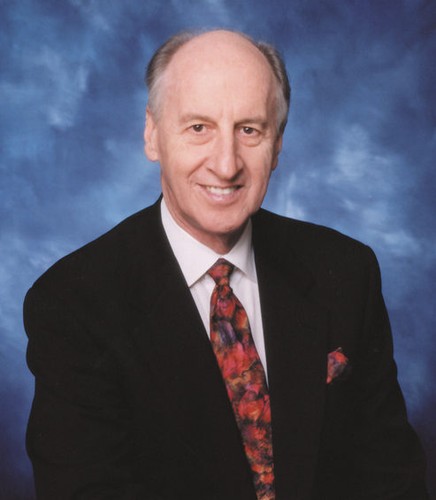
Jack W. Hayford
1934 · 0 books on FireSoul · International Church of the Foursquare Gospel, Life Pacific University, The King's University (formerly The King's College and Seminary, Van Nuys, CA)
Jack W. Hayford (1934, 2023) was an American Pentecostal pastor, broadcaster, and composer best known for growing The Church on the Way in Van Nuys, California from fewer than twenty attendees to over 12,000, for writing the worship song ‘Majesty’ in 1978, and for serving as the fifth President of the International Church of the Foursquare Gospel from 2004 to 2009. He authored more than fifty books on prayer, worship, and spiritual formation and was inducted into the National Religious Broadcasters Hall of Fame in 2014. His influence extended across denominational lines through his television program ‘Living Way,’ which aired on more than 500 stations beginning in 1991.
Biography
Jack Williams Hayford was an American Pentecostal pastor, broadcaster, composer, and author who spent more than five decades building institutions, training leaders, and writing the songs that a generation of Christians, far beyond his own denomination, still sing on Sunday mornings.
He was born on June 25, 1934, in Los Angeles, California, the son of two people whose quiet religious lives shaped him before any formal theological training could. His father, Jack Hayford Sr. (1911, 1979), had served in the military before settling into work as a switchman for the Southern Pacific Railroad. His mother, Anita Dolores, née Farnsworth (1916, 1997), taught the Bible at interdenominational women’s gatherings and spoke for Women’s Aglow Fellowship, a network that would eventually become Aglow International. His parents had married on September 28, 1932, and while Sunday attendance wasn’t always consistent, Hayford credited them throughout his life with giving him a Christian foundation that held when everything else was uncertain. He arrived with a muscular condition in his neck, which resolved over time. Childhood also brought a life-threatening illness and polio. Both he survived, and he publicly credited that survival to divine healing well into his eighties, without apology and without qualification.
The family settled in Oakland, California, where he went to Oakland Technical High School and graduated in 1952. He moved back to Los Angeles immediately after, enrolling at Life Pacific University, then still operating under the name L.I.F.E. Bible College, the same institution his denominational founder Aimee Semple McPherson had established to train Foursquare ministers. He completed his first bachelor’s degree there in 1956. College was also where he met Anna; the two married on July 4, 1954, while he was still finishing his undergraduate work. A second bachelor’s degree came much later, from Azusa Pacific University, where he graduated in 1970. That was fourteen years after the first degree, and he was already running a congregation by then. Most people wouldn’t go back for another undergraduate credential at that stage. That he did says something about how seriously he took the formation of his own mind, not just the formation of everyone else’s.
On February 25, 1945, at age ten, he gave his life to Christ. He returned to that date again and again across seven decades of public ministry, naming it precisely, the way someone marks a place on a map to explain where everything else is relative to it. He was still naming it in Nashville in 2014, standing before an auditorium full of broadcasting professionals and receiving the lifetime achievement award he’d been given by the National Religious Broadcasters. He opened not with career retrospective but with that single childhood afternoon. The consistency wasn’t performance. It was just how he understood himself.
His denominational home throughout his life was the International Church of the Foursquare Gospel, founded by McPherson in the early 1920s, and he served it in several capacities before he had a settled pulpit of his own. Among his early appointments was the role of National Youth Director, a position that put him inside congregations all across the country and gave him a working knowledge of American Pentecostalism that couldn’t be acquired from textbooks: its institutional rhythms, its persistent pastoral failures, the gap between what churches said they were and how they actually behaved. That ground-level education was formative in ways the formal degrees weren’t, and it ran underneath everything he built later.
An administrative turn came next. He served as Dean of Students at Life Pacific before being elected the college’s fourth president, a role he held from 1977 to 1982. During his presidency, in 1980, Life Pacific secured accreditation from the Association for Biblical Higher Education, a signal to peer institutions that Foursquare theological training could withstand external scrutiny. What makes the timeline unusual is that the presidential term ran alongside his pastoral work in Van Nuys simultaneously. He wasn’t postponing one responsibility for the other; he was carrying both at once. Whatever else this demonstrates about his temperament, it explains why Life Pacific, in its announcement of his death, called him one of the most influential Foursquare figures since Aimee Semple McPherson herself. That comparison, inside a denomination that holds its founder’s memory carefully, is not made casually.
Van Nuys, California was where the work that defined him publicly began in earnest. In 1969, he took over a small congregation there, then called First Foursquare Church of Van Nuys, with fewer than twenty people attending. He renamed it The Church on the Way and stayed for thirty years. By 1999, when he stepped out of the senior pastor role, the congregation had grown past 12,000 members, making it the largest church in the Foursquare denomination and one of the early exemplars of the megachurch model that was restructuring American Protestantism through the 1980s and 1990s. The raw numbers are striking. But they don’t account for the specific character of what he built.
What Hayford constructed in Van Nuys was a model of Pentecostal worship that stayed emotionally open without tipping into manipulation, and musically substantive without becoming stiff. Other pastors across the Los Angeles basin watched and tried to understand it. The Church on the Way became a reference point, a place people came to study when they were trying to figure out whether charismatic worship could be intellectually serious and genuinely alive at the same time. Hayford seemed convinced that the tension between those two things was mostly an inherited institutional anxiety rather than a real contradiction. His congregation was evidence. He also maintained working relationships across denominational lines, with Catholics, mainline Protestants, and charismatics from traditions far outside the Foursquare world. Doctrinal clarity is common enough among serious religious leaders; the capacity to hold the trust of competing factions while remaining plainly identified with your own convictions is considerably rarer. He had it.
Television entered the picture in 1977, when he launched his broadcast ministry. His program, “Living Way,” built steadily through the late 1970s and into the 1980s. By 1991, it was running on more than 500 stations and continued at that scale for eleven years. That distribution carried his voice into households with no connection to the Foursquare church, to Van Nuys, or to Southern California. He didn’t treat broadcasting as a secondary activity alongside real ministry; he understood it as ministry, a different format for the same work. In 2014, the National Religious Broadcasters inducted him into their Hall of Fame at the organization’s annual convention in Nashville. The NRB was seventy years old at that ceremony, and Hayford had been a visible presence in its world for nearly forty of those years. He honored the founding commitment of the organization “to stand for the truth, to be willing to take a position for things that become less popular all the time in society.” He was describing a continuing obligation, not a completed one.
His acceptance speech that evening is worth examining on its own terms, because it shows how his mind moved when the occasion called for retrospection. He didn’t survey his career. He didn’t thank institutional supporters. He went to John 13, the scene of Jesus washing his disciples’ feet, the exchange where Peter first refuses the gesture and then overcorrects by asking for hands and head as well. Hayford argued that Christians shouldn’t retreat from the unglamorous, difficult work of serving one another in places where nobody looks especially good. His central claim that evening was that followers of Christ face a persistent challenge: “remembering that we are called to love one another, but also to serve the world with the Gospel.” For a man standing before an audience assembled to honor a lifetime’s work, it was a conspicuously forward-looking use of the time. He wasn’t accepting a verdict on a finished life. He was still making a claim about what the next step should be, and trusting that the room understood why the distinction mattered.
“Majesty” was written in 1978 and has been ranked among the top 100 contemporary worship songs worldwide. It moved across denominational lines into Protestant congregations with no other connection to Pentecostalism, which is the clearest evidence that the song was doing something that transcended its origin. The theological compression in those few lines is deliberate: the majesty of God isn’t housed in formal liturgy or institutional ceremony but is present, active, and directly available to whoever comes to it. That drive toward immediacy, toward the concrete encounter over the abstract framework, ran through all of his compositional work. Altogether he wrote more than 600 hymns and choruses, a body of work large enough that “Majesty” can represent it without coming close to exhausting it. When Life Pacific University held a campus tent revival in February 2023, the month after his death, students performed a remix of the song as a tribute. According to the university, he had heard that remix in the weeks before he died and was delighted by what they’d made of it.
His written work covered comparable ground. He authored more than fifty books on pastoral theology, prayer, spiritual formation, and worship. Praying for Those You Love approached intercessory prayer not as a devotional attitude but as structured practice: the conviction that praying for specific named individuals is a form of active engagement, not passive hoping. It’s the kind of book that could only be written by someone who’d sat with real people through serious difficulty and watched what changed, and what didn’t, when prayer was deliberate. The Heart of Praise drew on his three decades leading congregational worship to work out a theology in which praise isn’t emotional warm-up for the sermon but a mode of perception, a way of attending to what’s actually true before the surrounding circumstances make it easy to see. Congregations at worship, in his account, weren’t generating spiritual feeling. They were training their attention. Rebuilding Your Life, issued in Spanish as Reconstruye Tu Vida, found readers across Latin America and the Spanish-speaking world, evidence that pastoral insight rooted in a specific Southern California Pentecostal community could travel across linguistic distance when the underlying observation was sound. Different books, different occasions, but the same sensibility running through all of them: always moving between contemplative ground and practical application, and making that movement look natural.
The broader Protestant and Catholic and Orthodox traditions have a long history of forcing their communities to choose between emotional aliveness and intellectual seriousness, as if these two things can’t occupy the same room. Hayford’s fifty years at exactly that crossroads is evidence the choice isn’t inevitable. He wasn’t an accidental ecumenist, he sought those conversations. And the fact that someone shaped so thoroughly by one specific denomination ended up trusted by people far outside it suggests that genuine theological conviction and genuine openness aren’t actually in conflict, however loudly the institutional gatekeepers on all sides insist they are. For anyone trying to live by something larger than themselves, wherever they come from, the demonstration that seriousness and aliveness can coexist in one life is not a minor thing.
He founded The King’s College and Seminary in Van Nuys, California, later renamed The King’s University and relocated to Texas, where he served as its Chancellor. Across the Foursquare denomination, his standing by the early 2000s was such that in 2004 he was elected as the fifth President of the International Church of the Foursquare Gospel, serving until 2009. He was seventy years old when he accepted that appointment. It was a formal ratification of what his peers had long understood: that what he’d built belonged to the whole movement, not only to the congregation in Van Nuys. During those years he was simultaneously Chancellor of The King’s University, senior statesman of a major denomination, continuing author, and broadcaster, a reach across institutions that would have been unusual for someone half his age.
Anna Hayford died on March 8, 2017, after more than sixty years of marriage. She’d been present through the twenty-person congregation years, through the growth to 12,000, through the television ministry, the college presidency, the founding of the university, and the Foursquare presidency. Her death preceded his by nearly six years. Hayford later married Valarie Hayford, and he leaves four children, eleven grandchildren, and a growing number of great-grandchildren.
Jack Hayford died on January 8, 2023, at eighty-eight. A public viewing was held on February 14 at Forest Lawn Memorial Park in the Hollywood Hills, with a memorial service following on February 18 at Shepherd Church in Porter Ranch, California, live-streamed for those unable to attend in person. Six weeks separated his death from the service, long enough for grief to settle into something more like gratitude. In the final weeks of his life, he had listened to students at the college where he’d once trained perform a new arrangement of a song he’d written forty-five years earlier, and he was delighted by what they’d made of it.
Core Teachings
-
Worship as Present-Tense Encounter
Hayford taught that congregational praise is not emotional preparation for the sermon but a mode of perception — a discipline of attending to what is actually true about God before circumstances make it easy to see. His theology of worship holds that the majesty of God is directly accessible, not mediated through institutional ceremony.
-
Intercessory Prayer as Active Practice
In works such as Praying for Those You Love, Hayford argued that praying for specific named individuals is a form of disciplined, active engagement rather than passive hoping, grounded in the expectation that deliberate prayer produces concrete change.
-
Charismatic Gifts as Ongoing Reality
Hayford consistently taught that ordinary Christians can expect direct encounter with the Holy Spirit and that the gifts described in the New Testament have not lapsed. He held this conviction without the sectarianism common in Pentecostal circles, maintaining relationships across Catholic, mainline Protestant, and charismatic traditions.
-
Servant Leadership and Mutual Love
Drawing on John 13 and the image of Jesus washing his disciples’ feet, Hayford taught that Christian leaders must engage the unglamorous, difficult work of serving others in places where no one looks especially good. His NRB Hall of Fame speech in 2014 centered on the call to love one another while serving the world with the Gospel.
-
Rebuilding and Renewal
Through works such as Rebuilding Your Life (Reconstruye Tu Vida in Spanish), Hayford applied pastoral theology to the concrete circumstances of personal crisis and restoration, reaching readers across Latin America and the Spanish-speaking world.
Quotes
“I think the challenge that we face is remembering that we are called to love one another, but also to serve the world with the Gospel.”
“You'll certainly agree with me that no matter how well-manicured your toenails are, the feet most certainly aren't the most beautiful part of your being.”
External Links
- Jack W. Hayford – Wikipedia (wikipedia)
- Life Pacific University – Obituary and Tribute (academic)
- Christian Post – NRB Hall of Fame Coverage, 2014 (interview)
- The Church on the Way – Wikipedia (wikipedia)
- Life Pacific University – Wikipedia (academic)
- International Church of the Foursquare Gospel – Wikipedia (wikipedia)
- Aglow International (Women's Aglow Fellowship) – Wikipedia (wikipedia)
- Forest Lawn Memorial Park, Hollywood Hills – Wikipedia (wikipedia)
- Charisma Magazine – Behind Every Good Man (archived) (archive)
- National Religious Broadcasters – Wikipedia (wikipedia)