
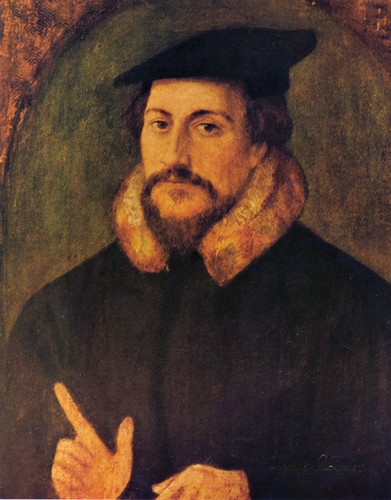
Jean Calvin
1509–1564 · 0 books on FireSoul · Reformed Christianity, Presbyterianism, Congregationalism, Continental Reformed, Calvinist Methodism, Reformed Anglican, Waldensians, Dutch Reformed, Huguenot
Jean Calvin (1509, 1564) was the French Protestant theologian whose systematic doctrines of divine sovereignty and predestination became the foundation of Calvinism, shaping Reformed churches across Europe and the Americas. After publishing the first edition of his Institutes of the Christian Religion in Basel in 1536, he settled in Geneva, where despite years of fierce civic opposition he built a model of church governance that spread through Knox’s Scotland, Huguenot France, the Dutch Reformed Church, and the English Puritan movement. His commentaries, sermons, and voluminous correspondence made him the most widely replicated theological systematiser of the Reformation.
Biography
Jean Calvin was the most systematically influential theologian of the Protestant Reformation, a French exile who remade a Swiss city into a laboratory for Christian governance and whose doctrines still shape hundreds of millions of believers across every inhabited continent.
He was born on 10 July 1509 in Noyon, a cathedral town in Picardy, France, into a family whose fortunes ran close to ecclesiastical power. His father, Gérard Cauvin, worked as an administrator for the local bishop, and that proximity shaped the boy’s earliest years in ways both practical and social. Calvin’s childhood companions in Noyon were drawn from aristocratic families tied to the church establishment, and those connections continued when, at fourteen, he left for Paris to study at the Collège de la Marche. The curriculum there was the full medieval seven: grammar, rhetoric, logic, arithmetic, geometry, astronomy, and music. Toward the close of 1523 he moved on to the more prestigious Collège Montaigu, an institution that had already shaped Erasmus and Ignatius of Loyola, though neither in directions its masters intended.
It was in Paris that Jehan Cauvin became Ioannis Calvinus, and eventually Jean Calvin. His original family name appears in historical records as Chauvin, Caulvin, or Cauvin, the variation reflecting regional and scribal differences in sixteenth-century French spelling. The Latinisation was standard practice for educated young men of the humanist generation, but it also marked a real shift in ambition and self-presentation. Part of his education was funded through income from a pair of small parishes, so the young Calvin remained materially bound to the Roman Church even as the intellectual air around him was changing. The new theological ideas coming from Luther and from the French biblical scholar Jacques Lefèvre d’Étaples were circulating through Paris in those years, and by 1527 Calvin had cultivated friendships with people who found those ideas worth taking seriously. But the decisive institutional pressure came from closer to home: his father, having watched the legal profession advance men of talent into wealth, advised his son to abandon theology and study law instead. In the preface to his later Commentary on the Psalms, Calvin wrote that his father had first destined him for theology, then changed course suddenly when he saw what the law could offer a man of ability, and that Calvin had obediently redirected his studies accordingly, God, by a secret providence, eventually turning his course elsewhere.
Calvin complied with his father’s direction. By 1528 he had moved to Orléans to read civil law, and over the years that followed he studied under various scholars at multiple centres, receiving what amounted to a thorough humanist education alongside his legal training. He was good at it. By 1532 he had completed his law studies and published his first book, a scholarly commentary on De Clementia by the Roman philosopher Seneca. The commentary was an exercise in humanist philology, not theology, and it showed a mind already capable of sustained analytical work. He was twenty-two when he finished it. But theology was not done with him.
The conversion, when it came, was sudden. Though Calvin offered no precise date, he reflected later that God had seized him without warning, breaking what he described as a stubborn attachment to Rome and reshaping a mind that, given his youth, had grown surprisingly resistant to change, bringing it, in his own words, to a teachable frame. He placed this somewhere around 1533, the same year he fled Paris. The immediate trigger was his association with Nicolas Cop, rector of the University of Paris, whose inaugural address that November drew on Lutheran and Erasmian ideas and provoked enough outrage that both men had to leave the city quickly. Calvin noted in the Psalms preface that almost immediately after this conversion, people hungry for purer doctrine began coming to him to learn, even though he was still what he called a mere novice and tyro. He found this unsettling. He was by temperament, he insisted, a man of the shade and retirement, unsuited to public notice, and yet wherever he tried to settle in seclusion, his retreats turned into public schools.
Calvin spent the next three years moving between places and sometimes identities, studying on his own, occasionally preaching, and beginning the work that would define the rest of his life. He withdrew from France, hoping to find the obscure corner of Germany or Switzerland where quiet study might be possible. He didn’t find it.
That defining work appeared in 1536: the first edition of the Institutes of the Christian Religion, published in Basel, the Swiss city where Calvin had taken refuge. He had gone there partly to escape, partly to think. While he was in Basel, the persecution of French Protestants intensified dramatically. The Affair of the Placards in October 1534, in which anti-Catholic broadsides appeared overnight across Paris and on the door of King Francis I’s bedchamber, had brought reprisals of real violence: burnings, mutilations, and the kind of cruelty that shocked Protestant sympathisers in German territories. The French court was circulating reports that those executed were Anabaptists and seditious troublemakers rather than sincere reformers, and Calvin saw exactly what that propaganda was designed to accomplish. In his own account, he watched the flames from Basel: holy persons burned alive in France while false pamphlets went abroad to insist they had deserved it, so that the killing could continue without exciting compassion. He wrote the Institutes partly as a refutation of that account, a work of apologetics addressed to Francis I himself, arguing that the people being killed were not fanatics but faithful Christians with a coherent theological position. It was also, from the beginning, a systematic account of that position, one he would revise and expand through several editions across his working life, the final Latin edition of 1559 expanding the original into a work of several hundred pages organised in four books.
The Institutes made him known. That notoriety changed everything in ways he hadn’t anticipated and didn’t welcome. Calvin had planned to travel from Basel to Strasbourg, where Martin Bucer was building a reformed church community he admired deeply. He called Bucer, in the preface to his Psalms commentary, “that most faithful teacher of the Church of God,” who had laboured in the field of biblical exposition with singular learning, diligence, and fidelity. A war between Francis I and Charles V forced a detour through Geneva in 1536, and in Geneva he was recognised. The French reformer William Farel had been working to establish the Reformation there and found himself short of the theological capacity the work required. He confronted the young scholar and, according to Calvin’s own account, threatened him with divine wrath if he used the inconvenience of war as an excuse to abandon Geneva for comfortable study elsewhere. Calvin was twenty-six, he wanted a scholar’s quiet life, and he found the prospect of Geneva’s fractious civic politics alarming. He stayed anyway.
He began in Geneva as a lecturer and preacher. But the city wasn’t ready for what he brought. Calvin and Farel worked to impose a rigorous scheme of Christian discipline, requiring subscription to a confession of faith and instituting regular oversight of moral conduct, and the governing council of Geneva pushed back hard. In 1538, both men were expelled. For Calvin this was not quite the disaster it might have been. He went to Strasbourg, where Bucer had long been at work, and spent three years there as pastor to a congregation of French-speaking refugees. He later remembered this period with something close to warmth: the theological conversations with Bucer, the calm of a city that accepted his ministry without constant resistance, the freedom to write and think. In 1539 he published a substantially expanded edition of the Institutes. He also married Idelette de Bure, a widow with two children, in 1540. She died in 1549, and Calvin did not remarry.
Geneva called him back in 1541. The city had struggled without his administrative capacity, and the council sent a delegation to Strasbourg asking him to return. Calvin described his feelings about this in letters to friends. He didn’t want to go. The Strasbourg years had given him something rare, and he knew what lay ahead in Geneva. But he went, and from 1541 until his death in 1564 he didn’t leave the city for more than brief trips.
The Geneva he returned to was not the Geneva he had left. It was not yet the Geneva he intended to build, either. What followed was more than a decade of conflict with some of the city’s oldest and most powerful families, the so-called Enfants de Genève, the Favre, Perrin, Vandel, Berthelier, and Ameaux families among them, who had helped win Geneva’s political independence and saw Calvin’s apparatus of church discipline as unwelcome foreign imposition. They resented him as a Frenchman. He wasn’t even a citizen until 1559. In the streets they called him “Cain” and gave his name to the city’s dogs. Opponents fired fifty shots outside his bedroom window on one occasion. They approached the communion table with what he described as the intention to wrest the sacrament from his hands, and he refused to yield, standing his ground in front of the assembled congregation. On another occasion, according to the account preserved in Philip Schaff’s history, he walked into an excited crowd in the street and offered his chest to their daggers. In letters to Farel on 14 December 1547 and to Pierre Viret three days later, he wrote that he could barely see how the church would survive his ministry much longer, that his power was broken. In a letter dated October 15, 1554, he told an old friend: “Dogs bark at me on all sides. Everywhere I am saluted with the name of ‘heretic,’ and all the calumnies that can possibly be invented are heaped upon me; in a word, the enemies among my own flock attack me with greater bitterness than my declared enemies among the papists.” It wasn’t defeat in the end, but the cost was real and sustained.
The opposition in Geneva had two distinct sources that often worked in concert. The Patriots opposed him on political grounds: they had invested too much in Geneva’s civic independence to accept what looked like the rule of a foreigner backed by other foreigners. They fought against the admission of French Protestant refugees to citizenship, worrying, with some justification, that the refugees would eventually outvote the native population. Calvin secured, in 1559, the admission of three hundred refugees to citizenship at one stroke, through a majority of the council that the Patriots couldn’t block. Those men could vote, and they did.
The religious opposition was separate from the political one, though the two frequently aligned. The Libertines, as Calvin called them, who styled themselves Spirituels, were a loosely organised antinomian movement whose intellectual roots, according to Calvin, ran back to Coppin of Yssel and Quintin of Hennegau in the Netherlands, and to a former priest named Pocquet who had briefly sought a certificate of good standing from Calvin in Geneva and been refused. Their theology amounted to a kind of pantheist antinomianism: because the spirit of God inhabited all creatures, everything any person did was in some sense done by God, and sin was therefore an illusion to be dissolved rather than a condition requiring discipline. Their practical ethics followed accordingly, including doctrines of common property and what Calvin described as the community of women, justified by tendentious readings of Scripture. He saw them as the most dangerous sect since the ancient Gnostics and Manichaeans, and he argued that case at length in his 1545 polemic Contre la secte phantastique et furieuse des Libertins qui se nomment Spirituelz, published in Geneva and issued in a Latin translation by Nicolas des Gallars in 1546 and a second French edition in 1547. The Libertines had managed to win sympathisers at the French court, including, to some degree, Queen Marguerite of Navarre, who had protected Calvin himself during an earlier period of flight and who died in 1549. When he attacked the sect in print, she took offence. Calvin wrote her a careful letter dated 28 April 1545, courteous but entirely unapologetic: a dog barks when it sees its master threatened, he told her, and he could hardly stay silent when God’s truth was under assault. He added that those who knew him were well aware he had never sought entry into the courts of princes, and that he had every reason to be content with the service of a master who had accepted him into an honourable office, however contemptible that office appeared to the world. It’s a letter that shows his particular kind of nerve clearly.
The conflict came to its most notorious point in 1553 with the trial and execution of Michael Servetus. Servetus, a Spanish physician and theologian who had already been condemned as a heretic by Catholic authorities in France, arrived in Geneva and was arrested, tried, and burned at the stake that October. Calvin had sought to have him executed by beheading rather than burning, but the council chose the traditional method for heresy. The case has followed Calvin’s reputation ever since, and it should. Theodore Beza, Calvin’s closest associate and eventual successor, later noted that Calvin’s handling of the Libertines helped contain that movement within the Low Countries; but the Servetus execution belongs to a different moral accounting. Whatever the complexities of sixteenth-century legal procedure and the near-universal Protestant and Catholic agreement that heresy warranted death, the burning of Servetus is a fact about Calvin and about Geneva that can’t be reasoned away entirely. Calvin believed Servetus’s anti-trinitarian theology was genuinely dangerous to the church. He also used the power of the state to kill a man for holding it.
By 1555, the tide shifted decisively in Calvin’s favour. The Perrin faction, the core of the Patriot resistance, overreached during a street disturbance that May and lost their political position. The admission of the three hundred refugee citizens gave the consistorial party a reliable majority on the council. The church discipline Calvin had designed was finally enforceable in the way he had always intended, and he was able to consolidate the institutional forms that Geneva would carry forward after his death.
Calvin’s theological system, which became known as Calvinism, rested on several interlocking claims. The absolute sovereignty of God was the structural premise: everything that happens, including the salvation or damnation of individual souls, follows from God’s will rather than from human choice or merit. The doctrine of double predestination held that God had determined before creation who would be saved and who would not, a determination that owed nothing to human virtue or foreseen merit. Salvation was granted, not earned, and granted selectively. This was, Calvin insisted, consistent with a rigorous reading of Augustine and of Paul, and he was prepared to follow the logic wherever it led, regardless of how troubling it seemed to those who wanted to anchor divine justice in terms humans could easily recognise.
The doctrine of Scripture followed from the doctrine of God. The Bible was the authoritative word, and it carried its own authority by what Calvin called the internal testimony of the Holy Spirit, rather than by institutional endorsement from Rome. This was a pointed reversal of the Catholic claim that the church authenticated Scripture. For Calvin, it worked the other way: Scripture authenticated itself to the believing heart, and the church’s task was to submit to it. He spent an extraordinary proportion of his working life in direct engagement with biblical texts. His commentaries eventually covered most books of the Bible, and they were notable for their relative brevity and their refusal of the elaborate allegorical readings that had dominated medieval exegesis. He read as closely as his humanist training allowed, attending to historical context and the literal sense of the text before reaching for theological application. Wolfgang Musculus was also producing substantial biblical commentaries in the same period, and Calvin acknowledged him in the Psalms preface as someone who had earned real praise for his diligence, another scholar working the same field who complicated any claim that Calvin’s contributions were simply without precedent.
The Psalms held a special place in his thinking. He called the book, in the preface to his commentary on it, “An Anatomy of all the Parts of the Soul,” arguing that every emotion a human being can experience was there represented as in a mirror, that the Holy Spirit had drawn to the life every grief, fear, doubt, hope, and perplexity the mind runs to. He found in the Psalms a model for prayer that was honest rather than performative, a form of speech that moved between faith and doubt without pretending the doubt wasn’t there. Genuine prayer, he argued, proceeds first from a sense of need and then from faith in God’s promises; the Psalms were the best school for both. He also found in David a figure whose struggles with internal betrayal and external hostility mapped directly onto his own situation, and he said so in the preface without embarrassment, comparing himself to David at great distance and noting the parallel between David’s enemies within Israel and his own domestic adversaries within the church. He’d spent three years lecturing on the Psalms in Geneva’s “small school” before he was persuaded, partly by the fear that pirated transcripts from his students’ notes would circulate without his corrections, to write the commentary up for publication. It began, as he told his readers, with a single experimental exposition of one Psalm, which went better than he’d expected, and grew from there.
The sacramental theology Calvin developed stood between Luther and Zwingli. Luther had insisted on a real bodily presence of Christ in the Eucharist, the body and blood materially present with the bread and wine. Zwingli had reduced the Lord’s Supper to a memorial, a symbolic re-enactment without any special divine presence. Calvin held that Christ was genuinely present in the Supper but spiritually, received by faith rather than physically consumed. The bread and wine were real signs of a real gift. This distinction mattered deeply to him, and he pursued it through sustained controversy with Lutheran theologians, including correspondence with Philipp Melanchthon, who shared many of Calvin’s sympathies but was never able to break fully with the Lutheran position on the Supper. His relationship with Heinrich Bullinger, the Zurich reformer who succeeded Zwingli, was more productive: the Consensus Tigurinus of 1549, a joint agreement on sacramental doctrine reached between Calvin and Bullinger, was one of the clearest expressions of the Reformed position and a significant step toward a unified Swiss Protestant front.
His ecclesiology was equally distinctive. Calvin insisted on four offices in the church: pastors, doctors or teachers, elders, and deacons. The elders, drawn from the laity, sat on the Consistory alongside the pastors and exercised the disciplinary oversight that was the visible mechanism of Calvin’s moral vision for Geneva. The Consistory could summon any citizen for examination, impose penance, and recommend excommunication in cases of serious offence, with civil consequences following. This machinery was what the Libertines and Patriots hated most about his regime. Calvin’s view was that church discipline wasn’t optional: an assembly without it wasn’t really a church at all, regardless of what it called itself.
His theology of civil government refused both the complete separation of church and state and the absorption of one by the other. Civil magistrates had a real and honourable calling under God, responsible for maintaining order, protecting the church’s freedom to operate, and suppressing open blasphemy and idolatry. They weren’t subordinate to the clergy, but they weren’t autonomous either. Mark J. Larson’s later study, Calvin’s Doctrine of the State (Wipf and Stock Publishers), traced how these ideas fed into American constitutional thinking, where the Calvinist suspicion of concentrated power and the emphasis on mutually checking institutions left a mark that outlasted the explicitly theological justification by centuries.
What strikes me, looking across this body of work, is the particular kind of courage required to build such a demanding system and then actually live inside it. Calvin’s God asks nothing comfortable. The doctrine of predestination doesn’t flatter; it insists that human beings are not the centre of the story and that their choices don’t determine the ending. And yet the people who have held this theology most seriously have so often been the most willing to act, to refuse, to resist, to build, to die for what they believed. There’s something in that paradox worth sitting with. Whether or not you share the theology, the tradition it generated is part of the inheritance we all carry, woven into the legal and political and educational structures of the modern West in ways that long predate easy agreement on their source.
Calvin’s correspondence was vast and reached across the entire Protestant world. Beyond his exchanges with Melanchthon and Bullinger, he wrote to reformers and rulers in France, England, Scotland, the Netherlands, and Poland, advising on church organisation, sacramental doctrine, and civil resistance. John Knox came to Geneva and called it the most perfect school of Christ since the apostles. That’s hyperbole, but it points at something real: Geneva under Calvin became a training ground and a model. French Protestant refugees arrived in numbers that strained the city’s capacity, studied at the Genevan Academy Calvin founded in 1559, and carried his theology and his ecclesiastical forms back to France or on to other Protestant territories. The Academy, which later became the University of Geneva, was among his most practically durable institutions. It trained the next generation of Reformed pastors and theologians, giving Calvinism an institutional base for reproduction that went well beyond what a single city’s church could otherwise have managed.
The theology spread further than any single institution could account for. Reformed churches across France, the Huguenot communities that would face the Wars of Religion after Calvin’s death, culminating in the St. Bartholomew’s Day Massacre of 1572, drew directly on his theology and on the organisational model tested in Geneva. The Dutch Reformed Church, built during the long struggle against Spanish Habsburg rule, was Calvinist in its confessional foundations. In Scotland, Knox built the Presbyterian structure that still defines the Kirk. The English Puritans who sailed for Massachusetts in 1630 carried the Institutes in their intellectual luggage if not always literally in their trunks. Congregationalism, as well as Presbyterianism, owed its ecclesiology to the Genevan model. Reformed Anglicans, the Waldensians in their Alpine valleys, the Hungarian Reformed Church: the network is wide enough that counting is less useful than noticing the pattern. Calvin was a systematiser, and systems coherent enough to survive transplanting tend to replicate across soil types.
His writing output was remarkable for a man who was chronically ill through much of his adult life and who simultaneously preached multiple sermons each week, lectured on theology, administered a church, conducted an international correspondence, and managed the politics of a city that frequently wanted to be rid of him. His sermons were taken down by stenographers and eventually published; the Plusieurs Sermons de Jean Calvin, edited by W.H.Th. Moehn and published in 2011, represents one scholarly effort to make this sermonic material accessible in critical form. The Congrégations et disputations, edited by E.A. de Boer and published in 2014, gathered the records of his formal scriptural disputations, the structured debates over biblical texts that he used as a teaching instrument in Geneva’s church community. The commentaries on individual biblical books appeared steadily through the 1540s and 1550s, each one the product of lecture series that were first transcribed and then revised for print. The Institutes went through major revisions in 1539, 1543, and 1559, the final Latin edition expanding the first version into a work of several hundred pages. He didn’t stop revising until he couldn’t hold a pen.
His correspondence also generated some of his most revealing prose. The letter to Queen Marguerite, the December 1547 letters to Farel and Viret in which he came close to despair, the extended preface to the Psalms commentary in which he traced the arc of his own calling by analogy with David: these aren’t the writings of a cold systematician. They’re the letters of a man under genuine pressure who still believed the work mattered enough to keep doing it. In the Psalms preface he acknowledged quite openly that his experience of conflict, with political enemies, with theological opponents, with the sheer administrative difficulty of governing a contentious community, had helped him understand what the Psalmists were actually describing. The book, he wrote, had worked on him as much as he had worked on it.
His health failed visibly from the mid-1550s onward. He suffered from gout, kidney stones, lung haemorrhages, and what contemporaries described as quartan fever. He dictated when he couldn’t write. In April 1564, too weak to walk to church, he was carried there to deliver what turned out to be his final sermon. He died on 27 May 1564, in Geneva, aged fifty-four. At his own request, he was buried in a common grave without a marker in the Plainpalais cemetery. He had spent his working life arguing against the veneration of places and objects, and he took that position seriously at the end.
The grave is still unmarked.
Core Teachings
-
Divine Sovereignty and Double Predestination
Calvin taught that God’s absolute sovereignty extends to the salvation and damnation of every soul, determined before creation without reference to human merit or foreseen virtue. This was his most controversial and consequential doctrine, derived from rigorous readings of Augustine and Paul.
-
Scripture as Self-Authenticating Authority
Calvin held that the Bible carries its own authority through the internal testimony of the Holy Spirit rather than through institutional endorsement, reversing the Catholic position that the church authenticates Scripture. This grounded his extensive biblical commentary work.
-
Church Discipline and the Four Offices
Calvin insisted on four church offices — pastors, doctors, elders, and deacons — with lay elders sitting on the Consistory to exercise moral discipline over the entire community. He regarded this structure as essential to a real church rather than optional.
-
Spiritual Real Presence in the Eucharist
Between Luther’s bodily presence and Zwingli’s bare memorial, Calvin located a genuine but spiritual presence of Christ in the Lord’s Supper, received by faith. This position was formalised in the Consensus Tigurinus (1549) with Heinrich Bullinger.
-
The Psalms as Anatomy of the Soul
Calvin described the Book of Psalms as ‘An Anatomy of all the Parts of the Soul,’ arguing it mirrors every human emotion — grief, fear, doubt, hope — and provides the most honest model for prayer, moving between faith and doubt without suppressing either.
Lineage
- Teachers
-
- Martin Bucer
- William Farel
- Jacques Lefèvre d'Étaples
- Students
-
- John Knox
- Theodore Beza
- Nicolas des Gallars
Quotes
“I have been accustomed to call this book, I think not inappropriately, 'An Anatomy of all the Parts of the Soul'; for there is not an emotion of which any one can be conscious that is not here represented as in a mirror.”
“Affairs are in such a state of confusion that I despair of being able longer to retain the Church, at least by my own endeavors.”
“Dogs bark at me on all sides. Everywhere I am saluted with the name of 'heretic,' and all the calumnies that can possibly be invented are heaped upon me.”
“God by a sudden conversion subdued and brought my mind to a teachable frame, which was more hardened in such matters than might have been expected from one at my early period of life.”
External Links
- John Calvin — Wikipedia (wikipedia)
- John Calvin — Calvin University / H. Henry Meeter Center (academic)
- Calvin's Commentary on the Psalms, Vol. 1 — Preface (CCEL) (archive)
- Philip Schaff: Calvin's Struggle with the Patriots and Libertines (CCEL) (archive)
- Calvin's Doctrine of the State — Mark J. Larson (Wipf and Stock) (publisher)
- Congrégations et disputations — E.A. de Boer (2014 scholarly edition review) (academic)
- Plusieurs Sermons de Jean Calvin — W.H.Th. Moehn (2011 edition) (academic)
- The Reformation — George Park Fisher (1912, Internet Archive) (archive)
- Calvin — Dictionary.com entry (archive)