
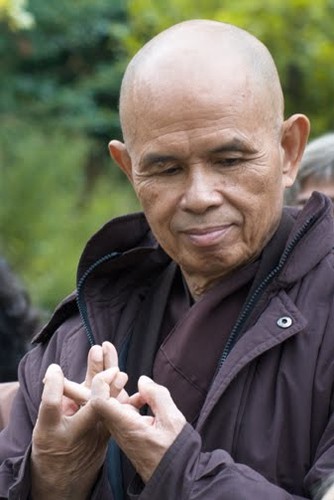
Thích Nhất Hạnh
1926–2022 · 13 books on FireSoul · Lam Te Zen (Linji/Rinzai), Lieu Quan Dharma line, Order of Interbeing, Plum Village Tradition
Thich Nhat Hanh (1926-2022) was a Vietnamese Zen monk who coined the term ‘engaged Buddhism,’ founded Plum Village monastery in France, and became known globally as the ‘father of mindfulness’ after Martin Luther King Jr. nominated him for the Nobel Peace Prize in 1967. He spent 39 years in exile before returning to Vietnam and eventually dying at the same temple where he’d been ordained as a teenager.
Books by Thích Nhất Hạnh


Biography
Ninety-five years old and unable to speak after a stroke, Thich Nhat Hanh went home to die. Tu Hieu Temple in Hue had taken him in as a sixteen-year-old novice back in 1942, and it was there, eight decades later, that he chose to spend his final years. Nobody engineered that symmetry. It’s simply what happens when an old monk decides where he wants his life to end. On January 22, 2022, monastics who had walked with him for decades gathered around his bed as he died.
Hue was also where he’d been born, on October 11, 1926, under the name Nguyen Xuan Bao. The city was once Vietnam’s imperial capital. His father, Nguyen Dinh Phuc, worked as a land-reform official for the French colonial government; his mother, Tran Thi Di, came from Gio Linh district in Quang Tri province and kept house. Six children arrived in that family, and he was the fifth. Fifteen generations separate him from the founding of the Nguyen Dinh line, and nine generations up sits Nguyen Dinh Chieu, the nineteenth-century poet who wrote the epic Luc Van Tien. There’s a small, telling detail from 1947: his mother received the Dharma name Trung Thinh, along with the Five Precepts, at Tu Hieu Temple itself, when she and his father came to visit their son shortly after Tet. By then the family’s life and his monastic life had become one thing. Before he turned five, home was his grandmother’s house within Hue’s old city walls, a place with a lotus pond and a bamboo grove, crowded with uncles, aunts, and cousins in the way Vietnamese extended families lived at the time. Everything changed when his father was transferred roughly five hundred kilometers north, to Thanh Hoa province, in the mountains; the rest of the family joined him a year later.
A magazine cover changed something in him around age nine. His older brother Nho had brought home an issue of Duoc Tue (“Torch of Wisdom”), and on its cover sat the Buddha, at ease on the grass, smiling. He couldn’t shake the image. Decades later he’d describe it as leaving “a lasting impression of peace and tranquility,” a feeling set against the poverty and injustice he watched daily under French rule, and he traced back to that moment his wish to become someone who could offer other people that same stillness. Two years or so passed. Then, at eleven, he sat with four friends after dinner, Nho among them, talking about what they’d be when they grew up. Nho spoke first: he wanted to become a monk. The rest agreed, one after another, and for Thich Nhat Hanh the choice barely required deliberation; by his own account he had already, as he put it, fallen in love with the Buddha. “During that discussion,” he said in a 1992 dharma talk, “it was clear that some decision or some aspiration was there very strong in me already.” That same year, on a school trip to a mountain the locals called Nui Na, he wandered off from his classmates during a rest stop, hunting for a hermit rumored to live somewhere on the slopes. The hermit never turned up. But thirsty and overheated, he found a spring, drank from it, and fell asleep on the rocks beside it. He’d later call this his first spiritual experience. A sentence in French came to him as he woke, unbidden: J’ai gouté l’eau la plus délicieuse du monde. I have tasted the most delicious water in the world.
His parents gave their consent, and in 1942, at sixteen, he entered Tu Hieu Temple in Hue as a novice under Zen Master Thich Chan That, who’d been born in 1884 and belonged to the lineage of Master Linji and Master Lieu Quan. The temple gave him the aspirant name Sung; there, he went by Dieu Sung. Nothing about daily life was easy. No electricity lit the buildings, no pipes carried water, no plumbing existed at all. He chopped wood. He hauled water from the well. He swept the courtyard, tended the cows, and during harvest season helped thresh and mill rice. “No work, no food” ran the temple’s Zen logic, and it bound the newest novice exactly as it bound the abbot. A small book called the Essential Vinaya for Daily Use was placed in his hands, forty-five short verses assembled centuries before by the Vinaya Master Duti, meant to be memorized and silently recited during the most ordinary chores, so that washing a bowl or ringing the temple bell turned into an act of complete attention. Dawn on the full moon of the ninth lunar month in 1945 brought his formal novice ordination. He took the Lineage name Trung Quang, meaning “Calm Light,” and the monastic Dharma name Phung Xuan, “Meeting Spring,” the name the temple would call him by from then on. His short 2002 memoir, My Master’s Robe, returns to these years, recounting how he and a fellow novice, Brother Man, pushed each other toward full ordination, yearning for it, in his words, “even more than a scholar might yearn for the announcement of the results of an exam.”
None of it unfolded peacefully. Japan occupied Vietnam through 1945, and that same year a catastrophic famine tore through the country. The teenage novice stepped outside the temple gates and saw bodies lying in the street, trucks hauling the dead away; he told a San Francisco Chronicle interviewer in 1997 that he never forgot waking to that sight morning after morning, nor the young students sent door to door begging rice to give the starving. Then the French came back to reclaim their colony, later in 1945, and the fighting widened into the First Indochina War, a conflict that would run until 1954 and kill more than fifty thousand people. Marxist pamphlets made the rounds among the young monks, pushing armed struggle, and he admits he wasn’t entirely deaf to their argument. Still, he came to a different conclusion: that Buddhism, stripped back to its root teachings, could hand Vietnam a nonviolent road toward the independence and prosperity he believed it once had under the medieval Ly and Tran dynasties. Tu Hieu itself turned sanctuary during those years, sheltering revolutionaries on the run from French forces.
His teacher sent him from Tu Hieu to the Bao Quoc Institute of Buddhist Studies, also in Hue, in 1947, so his training could continue even as the war ground on around him. Through the early 1950s he pressed for a modernized Vietnamese Buddhism, arguing that a tradition too wedded to ritual and hierarchy couldn’t answer the suffering of a country at war. Secular study at a university in Saigon made him one of the first Buddhist monks in Vietnam to attempt it; riding a bicycle made him one of the first six monks in the country to do that too, a small and almost funny fact that nonetheless captures something true about how he handled the line between monastic custom and the modern world pressing in on it. May 1, 1966, back at Tu Hieu: he received lamp transmission from Master Chan That and became a dharma teacher in the Lieu Quan line, forty-second generation of the Lam Te Zen school (called Linji in Chinese, Rinzai in Japanese), specifically a Vietnamese offshoot sometimes known as the Bamboo Forest School.
The early 1960s saw him found the School of Youth for Social Services, a grassroots relief organization that at its peak counted ten thousand volunteers rebuilding bombed villages, opening schools, running medical centers, and reuniting families the war had torn apart. He didn’t stop there. Van Hanh Buddhist University in Saigon, the La Boi publishing house, an influential peace-activist magazine, he founded these too, building, piece by piece, the institutional scaffolding any modern religious movement needs once its founder’s charisma alone won’t carry it. He crossed the Pacific in 1961 to teach comparative religion at Princeton, then moved the next year to Columbia for teaching and research in Buddhism. Vietnam was sliding deeper into war when he returned, and in 1964 he published a poem called “Condemnation” in a Buddhist weekly: I cannot accept this war. / I never could I never will. / I must say this a thousand times before I am killed. Some called him an antiwar poet after that; others called him a Communist propagandist. Refuse to pick a side in a civil war, and that’s roughly where you end up standing. His book Vietnam: Lotus in a Sea of Fire coined the phrase that would define his life’s work, “engaged Buddhism,” and in 1966 he founded the Order of Interbeing, grounded in the traditional bodhisattva precepts, with just six original members.
That same year he traveled to the United States and Europe to make the case for peace, and on that trip he met Martin Luther King Jr. for the first time. He pressed King to speak out against the war in Vietnam, and King did exactly that. King then nominated him for the Nobel Peace Prize in 1967, writing to the committee in Oslo that he knew “of no one more worthy” than “this gentle Buddhist monk from Vietnam,” whose ideas for peace, “if applied, would build a monument to ecumenism, to world brotherhood, to humanity.” Nobody won the prize that year. At home, the nomination and the friendship cost him everything. Both Vietnamese governments, North and South, barred him from returning, and what he expected to be a short absence stretched instead into thirty-nine years of exile.
He didn’t stop working, not for a single day the record shows. The Buddhist delegation at the 1969 Paris Peace Talks had him at its head. Through the early 1970s he lectured and researched Buddhism at the Sorbonne. When the Paris Peace Accords were finally signed in 1973, South Vietnam still wouldn’t let him in, so he made France his permanent home instead. Near Paris, in 1975, he built a small community called Sweet Potato; by 1982 he’d moved it to a larger site in southwest France, near Thenac in the Dordogne. Plum Village, he called it. Most accounts now rank it as the largest active Buddhist monastery in the West, home to more than two hundred resident monastics and drawing as many as eight thousand visitors a year who come to learn what he called the art of mindful living.
Interbeing was his name for the teaching at the center of everything, and it needs no footnote to any particular sutra, though one exists. Nothing has a separate self, not even a person; that’s the claim. Look closely at a flower, he liked to say, and sunshine turns up inside it, along with rain, soil, the gardener, the whole cosmos folded into one bloom, everything, in fact, except a separate flower-self standing apart from all the rest. We’re built the same way. “We cannot ‘be’ by ourself alone,” he told an audience at a State of the World Forum panel in San Francisco during the 1990s; “we must be with everything else.” He traced this straight back to the Diamond Sutra’s instruction to drop the notions of self, of humanity, of living beings, and of life span, teaching that the meditation practice of his own tradition, shamatha, existed precisely to keep that insight alive “twenty-four hours a day with the whole of our being.” None of this was abstract metaphysics for its own sake. It explains why contemplative practice and social action were never two separate tracks in his thinking, why a monk could sit in meditation one hour and organize flood relief the next and call both the same practice.
His teaching narrowed the word “mindfulness” down to something more usable than what wellness marketing later did to it: full presence to whatever is actually happening, breath by breath, step by step. Peace Is Every Step: The Path of Mindfulness in Everyday Life puts it directly: unless we’re truly present, fully ourselves in this moment, everything passes us by. Walking meditation, eating meditation, sitting meditation, total relaxation, working meditation, the simple triad of stopping, smiling, and breathing, he taught all of it, turning anything ordinary into an occasion for attention. His 1975 book The Miracle of Mindfulness did something quieter than sell copies, though it sold plenty. The psychologist Marsha Linehan called it something close to her working manual, her “bible” in her own words, and her use of it fed directly into what Mark Williams, emeritus professor of clinical psychology at Oxford and founding director of the Oxford Mindfulness Centre, would later formalize with colleagues as mindfulness-based cognitive therapy, now used against depression relapse worldwide. Williams didn’t hedge: Thich Nhat Hanh stood “at the very start of bringing mindfulness from east to west,” offering a bridge between ancient wisdom practices and modern psychological science. It’s an odd, almost accidental lineage when you trace it out, a Zen monk’s book about ordinary attention becoming clinical infrastructure decades after the fact.
Death didn’t get special treatment either, no separate terror walled off from the rest of experience. “Birth and death are only notions,” he wrote in No Death, No Fear. Illusions of thought, not facts of existence, that’s all they are. He meant it exactly the way he meant interbeing: the boundary we draw around a self, and therefore around that self’s ending, is a convenient fiction, useful sometimes, false always, and the whole practice is learning to let it go.
Here’s something worth sitting with. He insisted, over and over, with little patience for doctrinal turf wars, that his teaching on deep listening and compassionate presence ran through Christianity and Judaism just as naturally as through Buddhism. FireSoul exists partly because teachers like this one refused to fence off their insight. In front of Mikhail Gorbachev and a room full of Nobel laureates and heads of state, at that same State of the World Forum, he said mindfulness was “very much like the Holy Spirit,” that compassion is where “the rivers of Christianity and Buddhism meet.” He developed the whole argument at length in Living Buddha, Living Christ. This wasn’t syncretism dressed up for effect. Different traditions have been reaching toward the same water from opposite banks the whole time, and any library stocking only one bank would be lying about the river.
He didn’t stand alone once his teaching reached full stride. A wide circle of teachers, writers, and organizers gathered around him, and many extended his work in directions entirely their own. Roughly fifty senior students received his empowerment to teach in his name under the Order of Interbeing. The wider engaged Buddhism movement he sparked pulled in figures like the Zen teacher and social activist Joan Halifax, the scholar and environmental activist Joanna Macy, the writer bell hooks, the poet Deena Metzger, the mindfulness teacher Wendy Johnson, and the novelist Maxine Hong Kingston. Jack Kornfield and Sylvia Boorstein, American Vipassana teachers both, hosted him at retreat centers like Spirit Rock in Marin County, where a “Day of Mindfulness” once pulled more than two thousand people into an outdoor amphitheater; Ram Dass showed up for that same San Francisco leg of the tour. His publisher and longtime editor Arnie Kotler had brought some seventy-five of his books into print by the mid-1990s and sat on the board of the Community of Mindful Living; Kotler described the Order of Interbeing’s reach at the time as more than a hundred loosely affiliated sanghas practicing in his tradition around the world. Kotler also took care to place him within Buddhist lineage for Western readers who might assume Zen means Japanese by default, noting that Nhat Hanh practiced in the forty-second generation of a Vietnamese offshoot of the original Tang Chinese Lin-Chi lineage, and that Vietnam’s suppressed Unified Buddhist Church itself blended Mahayana and Theravada rather than sitting neatly in either camp. By the Thich Nhat Hanh Foundation’s own count, the wider network eventually surpassed a thousand local mindfulness communities, or sanghas, with Plum Village supporting a monastic body of more than six hundred monks and nuns across eleven monasteries in the United States, Vietnam, France, Hong Kong, Thailand, and Australia, plus an Institute of Applied Buddhism in Germany.
He wrote constantly. More than a hundred titles came out of him across meditation manuals, poetry, children’s stories, and commentary on classical Buddhist texts, and according to his foundation’s own accounting he sold more than five million books in the United States alone. Being Peace, The Miracle of Mindfulness, The Heart of the Buddha’s Teaching, and The Art of Living count among the best known. His later books tackled this century’s crises head-on. Zen and the Art of Saving the Planet argues that ecological catastrophe and the erosion of a person’s inner peace are really the same problem viewed from two angles, since, in his own words, the Earth is us. How to Fight treats conflict itself, personal and political both, as ground for practice rather than something practice is supposed to help you dodge. Earlier books like Anger, Going Home, and No Death, No Fear worked through specific difficult states rather than staying up at the level of general principle. That was typical of his method: start from the felt trouble, not the doctrine. He also worked as a calligrapher of real note. Short phrases and single words distilling his teaching, brushed onto paper, have hung in exhibitions since 2010 across Hong Kong, Taiwan, Canada, Germany, France, and New York.
Plum Village had already made him internationally known, but he kept traveling and kept teaching for years afterward. He addressed UNESCO in Paris on the links between violence, war, and global warming. He spoke at the World Parliament of Religions in Melbourne. He ran events for members of the US Congress and for parliamentarians in the UK, Ireland, India, and Thailand; he led retreats built specifically for veterans, and separate ones bringing Israelis and Palestinians together, treating reconciliation work as a direct extension of the same practice he taught to businesspeople and schoolteachers. A single 2013 US tour took him to Google’s Silicon Valley headquarters, to the World Bank, and to Harvard Medical School. We don’t need that much information.” He added that “nonthinking is the secret of success,” that unstructured time, met with attention, could outproduce work itself. Picture it: a Vietnamese Zen monk lecturing Silicon Valley on the limits of information. Strange scene, and exactly the kind his life kept generating, contemplative tradition walking straight into the most modern room available without flinching.
Thirty-nine years after his exile began, in 2005, a Communist government that had once barred his return let him back into Vietnam. He returned again to teach in 2007 and 2008; a 2008 talk in Hanoi drew a direct line between the Iraq War and the one he’d lived through at home, arguing both grew from fear and misperception that violence could never actually fix. “We know very well that airplanes, guns and bombs cannot remove wrong perceptions,” he said. “Only loving speech and compassionate listening can help people correct wrong perceptions. But our leaders are not trained in that discipline, and they rely only on the armed forces to remove terrorism.” His final return came in 2018, when he settled permanently at Tu Hieu Temple, his root temple, the same place he’d walked into as a sixteen-year-old boy seventy-six years before.
A severe brain hemorrhage hit him on November 11, 2014, a month past his eighty-eighth birthday. It left him paralyzed down his right side, unable to speak. He didn’t stop teaching, not exactly; those who visited in the years after described a continued, wordless presence, one that people who’d known him for decades said hadn’t really changed underneath. Anabel Temple, a member of his Heart of London Sangha who had traveled with him through China and Vietnam in 2005 and visited Plum Village many times since, remembered him as having “such humility, such dignity, such presence,” funny one moment and angry or sad the next, capable of childlike delight and profound calm inside the same hour. Suryagupta, chair of the London Buddhist Centre, first sat retreat with him in England some twenty-five years before he died; she recalled how silence fell over a room of hundreds the instant he entered, before he’d said a single word, and she noted, as a Black woman herself, how much his insistence that Buddhism belonged to everyone meant to her personally. Before he lost the ability to say much of anything, he asked his students for one thing: don’t lock his ashes away in an urn. If I am anywhere, he told them, it’s in your mindful breathing and your peaceful steps.
He died on January 22, 2022, at Tu Hieu Temple in Hue, ninety-five years old, inside the same building complex where he’d first learned, as a teenager under Japanese occupation, to sweep a courtyard with full attention. The Dalai Lama called his life “truly meaningful” and said the truest tribute would be to keep doing the work rather than mourn it. Marianne Williamson, the author and former US presidential candidate, said his love and compassion had “permeated the consciousness of the planet.” A week of funeral rites followed at Tu Hieu, held by Plum Village. Eleven monasteries remain, more than a hundred books, an order of monastics numbering in the hundreds, and one word, mindfulness, that has traveled so far from the Zen hall where he first taught it that most people who use it today couldn’t tell you whose garden it grew in.
Core Teachings
-
Interbeing
The insight that nothing, including a person, has a separate self; all things exist through mutual dependence, as a flower contains sunshine, rain, soil, and the whole cosmos.
-
Engaged Buddhism
A framework uniting contemplative practice with direct social action, coined in his book Vietnam: Lotus in a Sea of Fire and enacted through the School of Youth for Social Services.
-
Mindfulness as full presence
A narrower, more usable definition of mindfulness than modern wellness culture uses: full attention to breath and step, taught through walking, eating, and working meditation.
-
No Death, No Fear
The teaching that birth and death are only notions, illusions of thought rather than facts of existence, and that releasing this boundary allows a person to appreciate life anew.
-
Cross-tradition compassion
The argument that deep listening and compassionate presence run through Christianity and Judaism as naturally as through Buddhism, developed at length in Living Buddha, Living Christ.
Lineage
- Teachers
-
- Zen Master Thich Chan That
- Students
-
- Joan Halifax
- Joanna Macy
- bell hooks
- Deena Metzger
- Wendy Johnson
- Maxine Hong Kingston
- Arnie Kotler
- Anabel Temple
- Suryagupta
- Monastery / Center
- Plum Village Monastery, Thenac, Dordogne, France
Quotes
“During that discussion, it was clear that some decision or some aspiration was there very strong in me already.”
“We cannot 'be' by ourself alone; we must be with everything else.”
“Birth and death are only notions.”
“We have the feeling that we are overwhelmed by information. We don't need that much information.”
“If I am anywhere, it is in your mindful breathing and in your peaceful steps.”
External Links
- New York Times obituary (obituary)
- Lion's Roar profile (interview)
- The Guardian: from MLK to Silicon Valley (obituary)
- Nguyen Dinh Chieu reference (academic)
- Thich Nhat Hanh Foundation biography (foundation)
- Zen and the Art of Saving the Planet (publisher)
- Wikipedia: Thich Nhat Hanh (wikipedia)
- Plum Village official site (official_site)